



For over 15 years, the promise of BIM has echoed across industries like water: better data, better decisions, better operations. Yet today, critical sectors are waking up to a harsh truth. Traditional BIM, as it was conceived, is not delivering what operations and maintenance truly need. Razvan Gorcea, Utilities Director at Samp, investigates.
BIM is the process of creating a digital representation of an industrial site. In the water industry, where resilience, safety, and continuity are non-negotiable, the gap between BIM’s theoretical benefits and its real-world utility is becoming impossible to ignore.
Meanwhile, technology has advanced dramatically. In the past five years, 3D scanning has been revolutionised – faster, cheaper, more accessible. Scanning technology has been democratised. And yet, the dominant response of the BIM industry was to add even more complexity: using scans merely to create even bigger, heavier BIM models.
Instead of simplifying access to critical information, the “Scan-to-BIM” movement made digital operations even more complicated and expensive.
BIM has lost its way
Too often, we forget why BIM was invented. (Add why?)
Across hundreds of projects, I’ve heard the same mantra: “Don’t do BIM for BIM’s sake. Make sure it serves a purpose.”
And yet, when it comes to operations and maintenance, many BIM deliverables are created without any real operational purpose.
Asset owners are still demanding highly detailed As-Built Documentation – models that no one ever opens, neither in Revit nor in IFC. They become beautiful but useless artefacts. This disconnect is especially damaging in industries where asset performance is critical, like water treatment plants, distribution networks, and wastewater facilities.
BIM models are excellent tools for design and construction. They help during coordination, clash detection, and structured data management. But once the construction phase is over, the models often become dead weight – complex, expensive to maintain, and irrelevant for everyday operational needs.
The growing reality gap
In operations, simplicity and accessibility are key. Facility managers and maintenance teams need reliable, up-to-date information, not sophisticated 3D models requiring expert knowledge to navigate.
Instead, they are stuck operating in the “grey zone” between the outdated documents they have and the real-world assets they manage.
In the water sector, this has real consequences, including:
• Delayed interventions
• Increased risk of failures
• Higher maintenance costs
• Reduced resilience in critical infrastructures
The traditional BIM ecosystem, with its heavy reliance on specialised skills and complex software, simply does not fit the operational reality of water and wastewater utilities.
Why the water industry cannot afford this anymore
The stakes are rising.
Climate change, ageing infrastructures, cybersecurity threats, and regulatory scrutiny are all putting unprecedented pressure on water operators.
They must be able to trust their data and access it quickly to ensure service continuity, optimise maintenance, and prepare for the future.
Waiting months for model updates, or relying on outdated engineering drawings, is no longer acceptable.
A new approach: Scan-to-Value
While BIM models can meet the initial needs of designers or engineers, there is a major gap for models that are agile and responsive enough for operators – the people who manage and maintain daily critical infrastructure.
The traditional BIM process involves forcing a remodel of the facility into computer-aided design. But now, a smarter, faster solution is transforming this approach: Scan-to-Value.
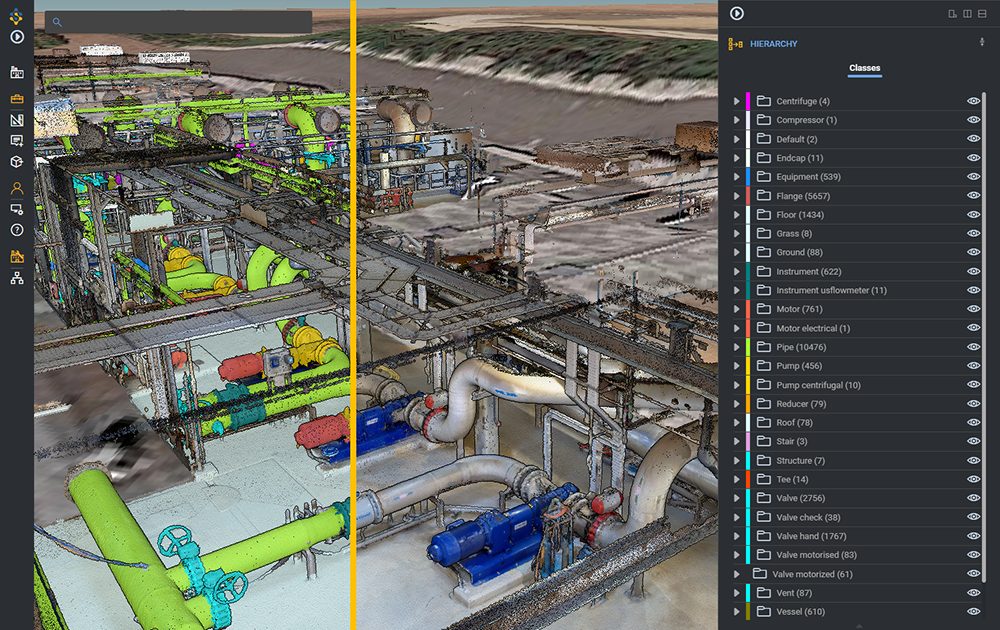
With Scan-to-Value, operators don’t need to recreate their existing sites in complex BIM models. Instead, AI algorithms automatically identify, segment, and classify the 3D point clouds, detecting everything from the oldest valves and pumps to the newest industrial technologies in the water facilities.
The resulting benefits of this approach include:
• A digital twin built for operations, not for show.
• A true mirror of reality, ready to be used by every technician, manager, and contractor.
• No need for long and costly remodelling processes.
Scan-to-Value is quickly spreading across industrial sites and changing the way asset owners think about digital transformation.
By interlinking 3D scans, equipment lists (1D), and P&IDs (2D) into an accessible, web-based portal, these site operators can access data that is easy to navigate and requires no special training to manage. It also means all teams and contractors have immediate access to the same shared reality of the site.
Crucially, as Scan-to-Value enables real-time verification and updates based on feedback from the field, these teams are viewing the most up-to-date information.
Conclusion: The death of traditional BIM is the rebirth of operational intelligence
Traditional BIM, in its heavy, design-centric form, is no longer fit for the operational realities of critical industries.
The future belongs to lightweight, operational-first digital twins solutions built for those who maintain, operate, and protect our essential infrastructure.
Solutions that bring clarity, trust, and efficiency. This is the mission of new developments like Scan-to-Value and why the technology is being adopted across a growing number of industrial sites.
And this is just the beginning. AI continues to learn and improve daily, driven by real operational feedback.
User interfaces are becoming simpler and more powerful, just like navigating a 3D Google Street View of your facility.
As a sector, it’s crucial we remain open to embracing these advancements and move away from traditional processes like BIM which are no longer suited for managing the operational reality of today’s critical industries.
By adopting this mindset, we can empower the water industry with the tools it needs to thrive in a world where resilience, transparency, and efficiency are non-negotiable.