



Scottish Water delivered its largest peatland restoration and woodland creation programme to date last year, helping improve biodiversity and protect source water quality across its landholdings as well as locking up carbon.
A record number of 50 energy efficiency projects – the most ever in a year – were also delivered, helping to reduce energy consumption, lower operational costs and provide customers with better value for money.
Carbon emissions were down by 10,892 tonnes of CO2e – the same as 1,237 return flights from Edinburgh to Sydney – while the utility’s total carbon footprint over the year was 2 per cent lower at 220,434 tonnes of CO2e.
The new figures have been published as part of the latest annual update measuring Scottish Water’s progress towards its net zero goals, showing the organisation remains on track to reach net zero by 2040.
Activities highlighted in the report include:
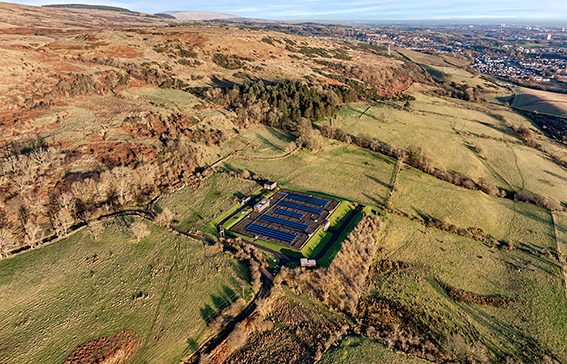
16 renewable schemes with 6.42 GWh renewable electricity generation capacity – enough to power 1,780 homes for a year
The largest peatland restoration programme to date with 555 ha restored supporting carbon capture alongside water quality, biodiversity and climate change resilience improvements – the same as 793 football pitches
Planting a record 208 ha of native broadleaf woodland with oak, alder, hawthorn, rowan and birch trees and confirmed the establishment of 95 ha of natural woodland regeneration – equivalent to half the size of Edinburgh’s Holyrood Park
The development of over 80 hydrogen projects with the potential to generate 7 GWh of hydrogen capacity with a focus on using final effluent from its wastewater treatment works.
Adding 79 cars to the electric fleet – bringing the total to 540
Using sustainable hydro-treated vegetable oil (HVO) which has 90% lower carbon emissions than diesel with our delivery partners, in fleet and standby generators.
Obtaining the PAS 2080 (Publicly Available Specification) certification for carbon management in buildings and infrastructure – the first public organisation in Scotland to do so.
Establishing the first solar and battery storage scheme on a water treatment works at Howden, near Selkirk – which will generate over a third of the site’s power usage.
Spokesperson Elise Cartmell said: “We remain on track to meet our targets and are delighted our total carbon footprint over the year reduced by 4,546 CO2e – the same as the energy use for 600 homes in a year.”