




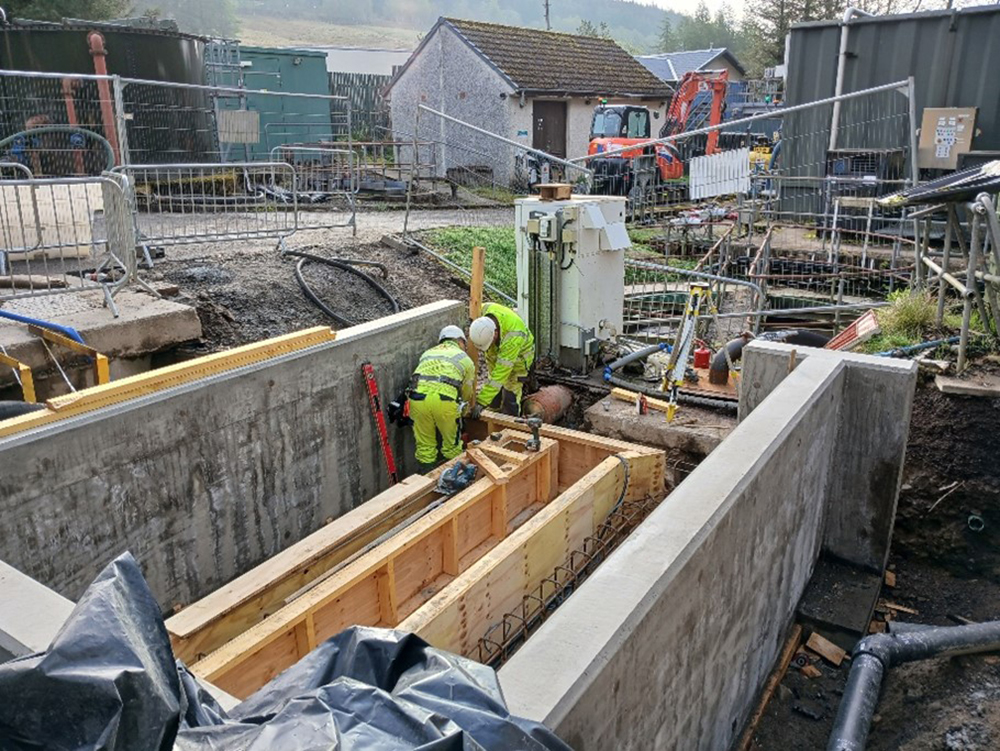
Tyndrum Wastewater Treatment Works, in Stirlingshire, has upgraded its process screening capacity by installing upgrades capable of handling more than triple its original volume.
The project, which took the site’s capacity from 3.2 litres per second (L/s) up to a possible 10.6 L/s, has been handed over to Scottish Water.
Screening incoming wastewater flows is a critical part to the treatment process, as it removes the large solid items that would cause damage and blockages to downstream equipment.
The age of the plant and its location within a small village supported by summer seasonal tourism, created challenges for WGM Engineering, which delivered the entire project from design to commission for Scottish Water.
The site also went through extensive testing before achieving final sign off.
Project manager Scott Ross said: “The screening upgrade work at Tyndrum has been a very rewarding but challenging project to be involved with, due to the environment and time constraints.
“The plant had to remain functional to continue serving the village, so temporary screenings and over-ground pumping were installed for the duration. Installation of these temporary screenings and the new upgraded screening faced unforeseen hurdles due to the age of the existing infrastructure on-site.
“Tyndrum WwTW was first built in 1981 and has gone through some smaller upgrades in the past. As a result, several uncharted services were discovered at critical locations of the planned construction works.
“This presented many challenges and saw our design be redrafted multiple times during the project. Compliance regulations meant we couldn’t simply remove these existing services or go around, under or over them. Any newly laid electrics or water pipes need to maintain specific distances from other buried services and from the surface, presenting a challenge for the design team.”
The village of Tyndrum, located on the West Highland Way, is a popular tourist destination, so work had to be completed within a tight seven-month window.
WGM’s site team used ground excavation techniques that don’t break ground in traditional ways, avoiding the risk of hitting unknown cables or pipes.
Scott said: “Vacuum excavators were used, which greatly reduced the need for any mechanical digging, and aligned with Scottish Water’s ‘zero strike’ policy for services.
“Our design team was tasked with and delivered a solution that increased the lifespan of existing assets, removing the need to demolish the current site and build a new treatment plant.
“WGM worked with surrounding landowners in the area and was able to reuse some of the construction materials to provide hardstanding areas, additional parking for local businesses and improved boundary fencing. We estimate a carbon saving of 10–11 tonnes of CO2 equivalent.
“The mechanical, electrical, instrumentation, control and automation (MEICA) installation also required modifications to the existing electrical control panel. The panel was the original one and therefore didn’t have the capacity for the newly installed infrastructure. This also required an upgrade to fully integrate the new screens.”
Scottish Water project manager Robin Johnson said: “At Tyndrum WwTW, our collaboration with WGM Engineering delivered an efficient, low-carbon retrofit that kept the works online while more than doubling screening capacity.
“By working together to navigate legacy services and a tight seasonal window, we strengthened resilience, improved compliance with environmental consents and minimised disruption for customers, the local community and stakeholders.
“This upgrade future-proofs a critical stage of the treatment process and supports Scottish Water’s commitment to sustainability and value for money.”