



Water scarcity is no longer a future risk. It is a present and growing global challenge.
Across the world, up to 70 percent of regions face seasonal water stress.1,2 Climate change continues to disrupt the water cycle, increasing pressure on already strained infrastructure.
At the same time, large volumes of treated water never reach consumers. Losses occur through leakage, operational issues and increasingly, theft.
While water theft is often overlooked, other industries (e.g. oil) have already faced theft challenges head-on.
What oil pipeline theft can teach the water sector
Oil theft becomes a major issue during periods of high oil prices and supply instability. In the UK, pipeline theft incidents began to rise around 2014 creating losses that were difficult to detect using conventional monitoring systems.
The challenge was not just the theft itself, but how it appeared in operational data. Events were often small, intermittent and designed to avoid detection. Traditional SCADA systems, with lower resolution data, struggled to identify these subtle anomalies.
The response required a shift in approach. Rather than relying on a single detection method, operators adopted a multilayered strategy that spans legal, social, economic and technological areas. High-resolution instrumentation, real-time monitoring and advanced analytics were combined to identify unusual pressure and flow patterns.
This approach delivered measurable results. In the UK, the use of advanced theft detection technologies helped reduce pipeline fuel theft by more than 90 percent.
The lesson is clear. Theft is not only a security issue. It is a challenge that requires precision, visibility and multiple layers of detection.
The growing risk of water theft
Water networks are now facing similar pressures. As scarcity increases, the value of water rises. This creates both economic and social drivers for unauthorized extraction.
Unlike oil, water theft is often hidden within broader categories such as non-revenue water (NRW) or unmetered consumption. This makes it difficult for operators to distinguish between leakage and theft without the right level of insight.
In many regions, losses already exceed acceptable thresholds. Brazil is a clear example, where around 38 percent of water is lost before it reaches consumers.3
The challenge is not just the volume of loss, but the uncertainty around its cause.
Case study: Distinguishing between leakage and theft in South America
A South American water utility identified a section of trunk main (see Figure 1) where approximately 45 percent of flow was being lost.
Figure 1: 12 km pipeline section experiencing significant losses, with around 60 percent attributed to non-revenue water loss with a strong suspicion that theft accounted for the majority of the NRW, featuring multiple offtakes, limited metering coverage and minimal pressure monitoring due to basic customer-installed transmitters.
At this stage, the root cause was unclear. The losses could have been caused by leakage, theft or a combination of both.
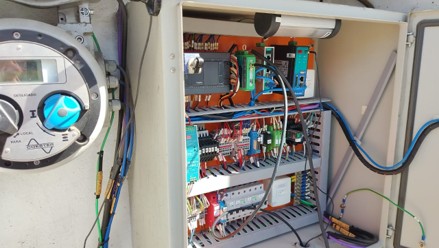
A pilot study was introduced to address this uncertainty. Using high-resolution monitoring and advanced detection techniques (see Figure 2), the system was able to identify and locate simulated leaks with a high degree of accuracy. Even under challenging conditions such as intermittent flow and data quality limitations, the results were strong.
High-resolution monitoring also helps differentiate between leakage and theft. Leakage events typically create continuous or gradually changing hydraulic signatures, while theft-related activity is often intermittent and irregular. By analyzing these patterns in real time, operators gain greater visibility into the likely cause of loss.
Figure 2: Atmos data acquisition units plugged into the existing instrument cabinet
Figure 3: The two leak locations pinpointed by Atmos
The system demonstrated the ability to detect and locate events within 1 to 2 percent of the monitored pipeline length, even at relatively low flow rates.
This level of visibility allows operators to move beyond assumptions and take targeted action.
Why a multilayered approach matters
The experience from both oil and water shows that theft detection requires a combination of technologies and operational practices working together.
Operators should be asking critical questions:
Are current systems capable of detecting small, transient events?
Is data resolution high enough to distinguish between normal operations and anomalies?
Can the system differentiate between leakage and theft?
How quickly can a theft event be detected and located?
Is there a clear process to validate and respond to detections?
A multilayered approach typically combines high-frequency data capture, real-time monitoring, advanced analytics and structured response workflows.
This does more than detecting a theft. It strengthens overall network visibility, supports leakage reduction and improves operational decision-making.
From reactive to proactive water management
As global water stress intensifies, utilities can no longer afford to treat water losses as a single, undefined issue.
By applying lessons from the oil industry and adopting advanced detection technologies, operators can shift from reactive responses to proactive management.
Water theft may still be underreported, but it is not undetectable. With the right approach, it can be identified, quantified and addressed as part of a wider strategy to protect critical water resources.
References
1 https://www.unwater.org/water-facts/water-and-climate-change
2 https://www.worldwildlife.org/threats/water-scarcity
3 https://agenciabrasil.ebc.com.br/en/geral/noticia/2019-06/more-38-brazils-treated-water-wasted