



Innovation in the water industry is increasingly driven by the ability to adapt proven technologies to address persistent infrastructure challenges. One of the most critical issues is the management of thermal movement in large concrete water-retaining structures, where temperature fluctuations can lead to cracking, reduced watertightness and shortened asset life.
Recognising thermal variation as a significant long-term risk, Triflex worked in collaboration with Mott MacDonald and Mott MacDonald Bentley to develop a new technical approach to better stabilise deck temperatures and improve structural resilience. The result is a meaningful step forward in the protection of vital drinking water infrastructure.
Proven in potable water storage asset protection
The methodology was first developed during the refurbishment of an existing service reservoir, where Mott MacDonald engineers identified thermal variation as a key risk to long-term performance, as well recognising waterproofing membrane properties to enhance durability.
Building on this success, the same approach was subsequently adopted on a newly constructed storage reservoir, confirming its effectiveness across both refurbishment and new build applications. The transition from project-specific solution to repeatable approach highlights its potential as a reliable strategy for improving resilience across the water sector.
Reducing thermal variation of concrete service reservoir roof
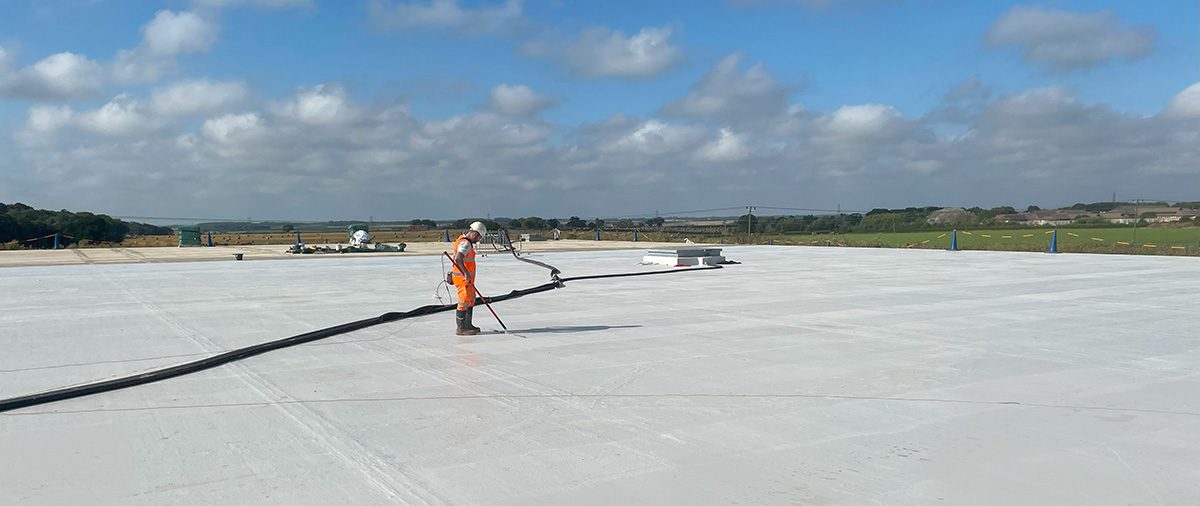
At the core of the innovation is a Triflex inverted warm roof build-up incorporating 50mm XPS insulation above the structural deck. This acts as a thermal buffer, reducing rapid temperature fluctuation. Coupled with this is the dynamic crack bridging cold liquid applied waterproofing membrane, Triflex ProTect.
By maintaining a more stable temperature profile, thermal stresses within the concrete roof were reduced. This helps minimise the risk of cracking and supports long-term structural performance, demonstrating the value of integrating thermal management into such asset types.
Waterproofing and structural protection
The cold liquid applied waterproofing membrane forms a seamless, fully bonded layer across the substrate. This eliminates joints and laps, which are often the weakest points in traditional systems, resulting in a more robust and reliable barrier. An important consideration for buried systems.
A key performance characteristic is the ability to accommodate movement within the structure. Certified to BS EN 1504-2 with a B4.2 (-20°C) dynamic crack bridging classification, the liquid applied membrane can withstand both fine and more significant substrate movement, even at very low temperatures. This ensures that waterproofing performance is maintained over time, despite environmental and structural stresses.
Durability and long term assurance
Durability remains a central consideration for water infrastructure, where access can be restricted and interventions costly. The waterproofing membrane is supported by independent BBA certification confirming a service life in excess of 25 years, providing confidence in long-term performance. Already proven in the wider built environment, Triflex PMMA systems are inherently hydrolysis resistant, UV stable and offer outstanding waterproofing in the toughest environments.
The ability to simply overlay the system at end of life offers further sustainability benefits, reducing waste and extending asset life without the need for full removal and replacement.
Efficient delivery and programme certainty
Rapid curing properties supported efficient and predictable installation. The system becomes rainproof in as little as 30 minutes, and achieves full cure quickly, even in winter temperatures. This enabled work to proceed within limited and changeable weather windows, prioritising programme certainty and maintaining consistent delivery schedules. For the water sector, where minimising operational disruption is essential, this offers a clear practical advantage.
A future focused approach
This approach demonstrates how innovation can deliver tangible improvements in asset protection. Here, innovation is not about reinventing materials but about integrating them more effectively to deliver greater value. The combination of thermal control, advanced PMMA waterproofing and proven durability provides a practical, repeatable solution for safeguarding critical infrastructure.
As the water sector continues to prioritise long-term asset performance, integrated and performance-led solutions such as this will play a vital role in enhancing resilience, supporting sustainability and maximising whole-life value.
To learn more about how advanced waterproofing and inverted build-up approaches can support long-term asset protection, visit www.triflex.co.uk and explore the latest solutions for the water sector.