




Finding a water leak is not always as straightforward as listening for it. As more of the UK water network transitions to plastic pipes and utilities face increasingly stringent leakage targets, operators need additional ways to detect leaks quickly and accurately.
Tracer gas provides one answer. This method can locate leaks that conventional acoustic equipment struggles to detect, while providing field teams with a relatively simple process for narrowing down the location of a defect before excavation begins.
The principle is straightforward. A tracer gas, usually a mixture of 5% hydrogen and 95% nitrogen, known as forming gas, is introduced into the water main or service. At this concentration, the mixture is non-flammable and can be used safely within the network.
Hydrogen is particularly useful because it is the smallest gas molecule. It can escape through very small defects in a pipe and, because it is lighter than air, travels upwards through the surrounding ground. Once it reaches the surface, engineers can detect it and trace the leak back to its source.
Rather than relying on acoustic methods that listen for the leak, the operator uses a detector to trace escaping hydrogen at the surface. It makes the technique particularly valuable for plastic pipes, where acoustic location results can be poor.
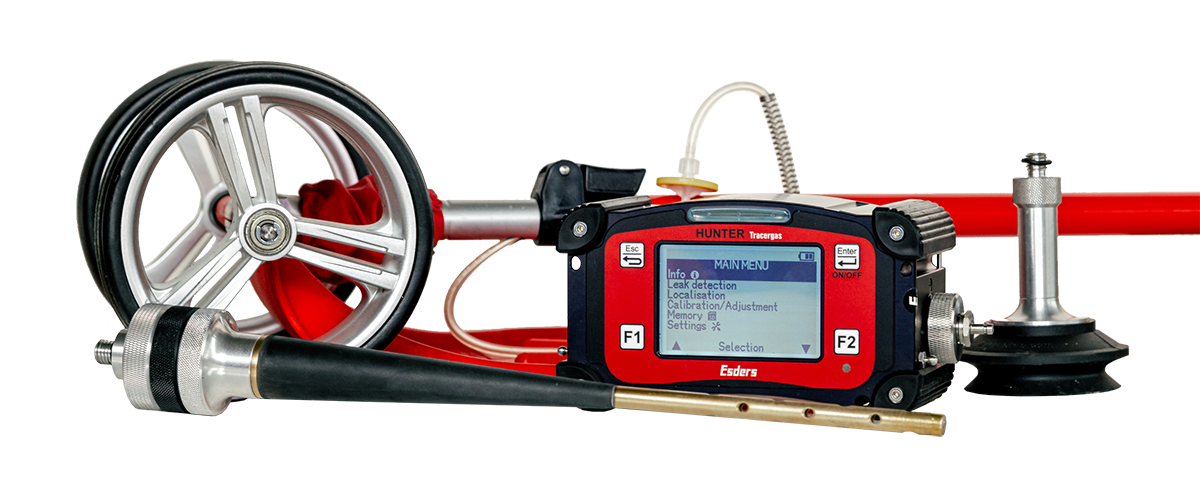
The Esders system provides the equipment to manage the whole process, from injection through to final pinpointing.
Gas is introduced from a high-pressure cylinder through a pressure reducer at an accessible point, such as a hydrant or a dismantled water meter. An injection system such as the Esders TIB 40 is then used to control the amount of tracer gas entering the main.
The required dose will depend on factors including water flow, pressure, temperature and the suspected size of the leak, but typically represents between 2% and 10% of the water flow.
Once the gas has been introduced, sufficient time must be allowed for it to travel through the water, escape through the defect, and migrate towards the surface.
The operator can then begin surveying the pipe route using an Esders HUNTER Tracer Gas detector. Fitted with a carpet or bell probe, the instrument detects hydrogen as it reaches the surface, allowing the technician to progressively narrow the search area.
Where the leak is particularly small, or ground conditions make detection more difficult, a mobile vacuum pump can be used with a specialist bell probe to draw gas from the surface into the detector.
Once the likely location has been established, a borehole probe can be used to measure gas concentrations in the soil and pinpoint the strongest reading, providing final confirmation before excavation.
The same principle can be applied to service connections. Tracer gas can be introduced through a meter connection and allowed to flow back towards the suspected leak. It can also help investigate concealed pipework. Because hydrogen can penetrate materials including brick and render, engineers can investigate pipework behind walls using the detector with an appropriate probe.
For utilities, the benefit is not simply finding a leak. It is finding it with greater confidence, where every unnecessary excavation carries a cost, from labour and traffic management to reinstatement and disruption for customers.
There is also a practical consideration when investing in equipment. Esders systems are supported in the UK through Synthotech, with approved repairs available domestically and spares and consumables held in stock. Current equipment is also compatible with previous models, including PrimeTrace, helping utilities continue using existing equipment rather than replacing an entire fleet.
Tracer gas will not replace every established leakage technique, but it does provide a valuable additional tool.
As leakage targets tighten, the ability to quickly find difficult leaks, confirm their position, and dig once in the right place is increasingly important.
For more information about Esders tracer gas leak detection equipment, contact Synthotech.
synthotechwater.com