




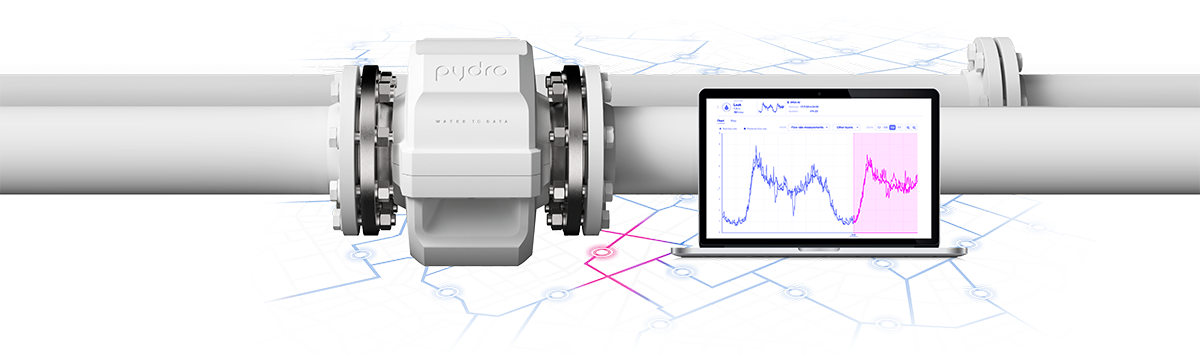
Advanced NRW management and digital twins depend on continuous field data. Pydro’s self-powered PT1 is designed to remove the power, maintenance and integration barriers that stop real-time DMA monitoring from scaling.
TWater utilities must operate vast, ageing networks with greater precision. In England, close to a fifth of the water put into supply is lost through leakage, and Ofwat’s AMP8 determinations require a further 17 per cent cut by 2030. The challenge is not simply finding a leak, but knowing quickly which DMA has changed and where to direct field crews. The same visibility gap constrains pressure optimisation, predictive maintenance and digital twins, none of which can outperform the field data they are built on.
Scaling that visibility is difficult. Many DMA measurement points sit in remote or flooded chambers with no mains power. Conventional architectures combine a meter, a battery-powered logger, a communications unit and software. Higher measurement and transmission rates shorten battery life, while grid or solar power adds cost, civil works and siting constraints. The result is recurring maintenance visits, fragmented data and an architecture too expensive to replicate across hundreds of DMAs.
The PT1 is an all-in-one, in-line, self-powered monitoring unit for DMAs. A patented internal turbine harvests energy from the flow, while integrated sensors measure flow, cumulative volume, pressure and temperature. The device transmits minute-level data over LTE-M, NB-IoT or 2G, including from IP68-rated flooded chambers, with no external logger, routine battery replacement or grid connection. Data can pass through MQTT and other interfaces into a utility’s existing SCADA, analytics or digital-twin environment. Pydro, founded in Germany in 2016 and certified to ISO 9001:2015, holds DVGW and WRAS drinking-water approvals.
Within the leak detection value chain, the PT1 sits at early detection and prioritisation: continuous flow and pressure data flag abnormal DMA behaviour and point crews at the right zone. That data can feed AI analytics and hydraulic models before acoustic loggers, correlators, ground microphones or tracer gas localise and confirm the leak. The PT1 complements those tools rather than replacing them.
“Utilities do not need another isolated sensor or dashboard. They need a dependable data layer that can scale across the network and feed the systems they already trust,” says Mulundu Sichone, Co-founder and CEO of Pydro.
At Acque Bresciane in northern Italy, Pydro’s partner Aquanexa led a PNRR-funded DMA digitalisation programme with the PT1 as the real-time monitoring layer. Across 79 km of distribution network, four DMAs were implemented and 27 leaks identified, with an estimated 22 per cent reduction in water losses from leak detection activities alone. In one event, the PT1 flagged a sudden flow increase immediately, allowing investigation and repair within hours rather than days. In a two-stage evaluation with SUEZ, laboratory metrology was followed by a 12-week field trial that returned 98 per cent uptime on minute-level data and a weekly absolute mean error of 0.81 per cent against a reference meter.
The PT1 is now available in the UK, with WRAS approval and engagements under way with major utilities. Ipsum Group is Pydro’s UK partner, contributing an installation workforce of more than 1,000 people across 40 locations, established utility relationships and capability in deployment, systems integration, maintenance and asset management. That is the local layer needed to move from focused evaluations to repeatable AMP8 rollout.
“Our ambition is to turn the energy already moving through the network into the intelligence needed to protect water, without adding batteries, power cables or another data silo,” Sichone adds.
For utilities, the practical starting point is a focused group of high-loss or poorly instrumented DMAs, measured on data availability, time-to-detect, field visits, time-to-repair and water saved, then scaled on evidence.
pydro.com