



Reducing leakage has become one of the biggest challenges facing water utilities across the UK. With growing pressure on water resources, increasing customer expectations, and stricter regulatory requirements, utilities are being asked to deliver significant reductions in water loss while maintaining reliable service and controlling operational costs.
The challenge is substantial. The UK water industry has committed to halving leakage by 2050 according to Water UK’s Leakage Routemap, while the UK Government’s Environment Act delivery framework includes interim leakage reduction targets of 20% by March 2027 and 30% by March 2032 (against a 2017–18 baseline).
Achieving these goals requires utilities to find and repair leaks faster than ever before. Traditional leak detection methods often rely on periodic surveys, which can allow hidden leaks to remain undetected for weeks or months. During this time, valuable treated water is lost, contributing to Non-Revenue Water (NRW) and increasing operational costs.
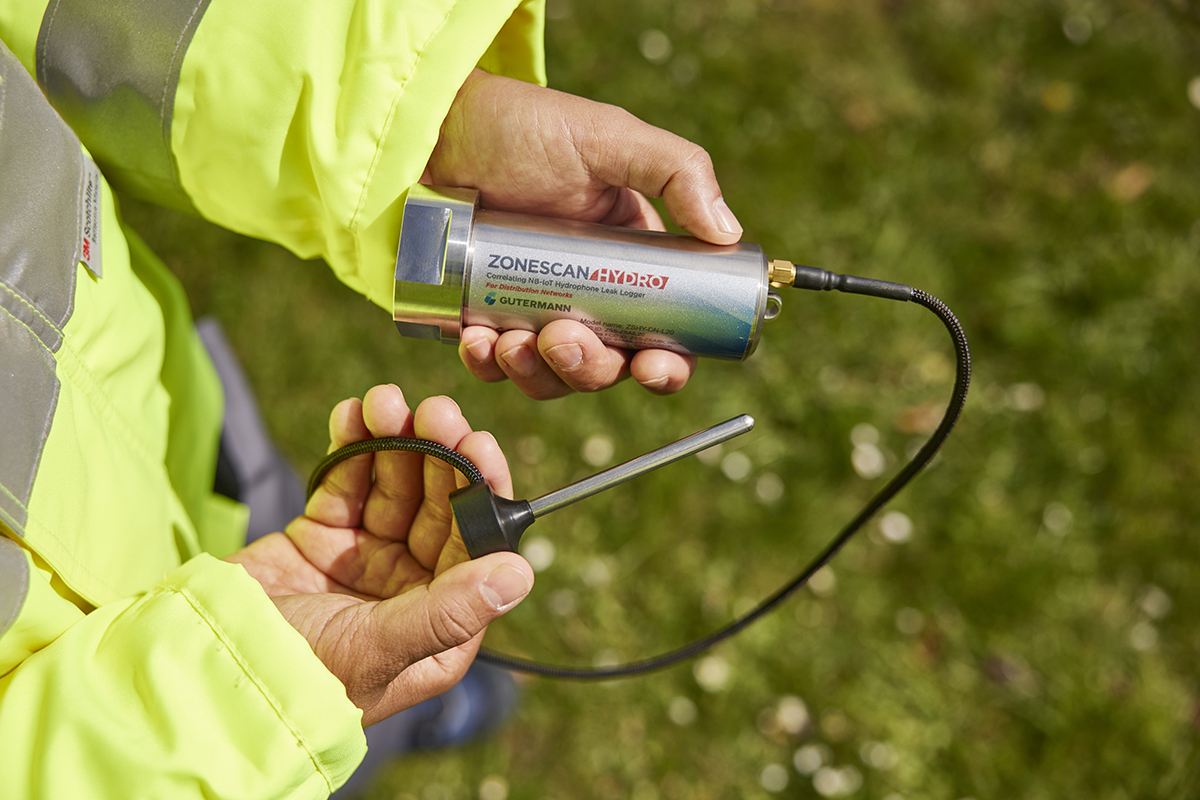
ZONESCAN HYDRO has been developed specifically to help utilities address this challenge. Combining highly sensitive hydrophone technology with NB-IoT communications and advanced cloud analytics, the system provides continuous monitoring of water distribution networks, enabling leaks to be detected and located much earlier than conventional approaches.
Particularly effective on plastic pipe networks, ZONESCAN HYDRO can detect leak noise in conditions where traditional acoustic systems may struggle. Using GUTERMANN’s advanced correlation technology, neighbouring loggers automatically analyse leak signals and pinpoint leak locations with industry-leading accuracy. This helps field teams quickly locate problems, reduce investigation time and minimise unnecessary excavation.
The benefits for water utilities are clear. Earlier leak detection reduces water losses, lowers repair costs and allows maintenance teams to focus resources more effectively. Continuous monitoring also supports a proactive approach to leakage management, helping utilities identify emerging problems before they develop into major bursts or service interruptions.
Beyond helping utilities achieve regulatory targets, reducing NRW delivers wider environmental benefits. Every litre of water saved reduces the energy required for treatment and pumping, conserves finite water resources and strengthens resilience against future droughts and water shortages. Globally, improving leak detection is recognised as one of the most effective ways to improve water sustainability and secure long-term water availability.
Proven Performance on Plastic Pipe Networks
Interest in ZONESCAN HYDRO continues to grow throughout the UK water industry, with recent purchases by both Portsmouth Water and Wessex Water being driven by proven performance in operational environments across the globe. A recent installation in Norway highlighted the system’s capability to deliver reliable acoustic leak detection on challenging plastic pipe networks.
Lier VVA KF is the municipal water utility serving Lier Municipality in Norway. The organisation is responsible for the operation, maintenance and development of the municipality’s extensive water distribution and wastewater infrastructure.
Lier VVA KF deployed ZONESCAN HYDRO to monitor a 160 mm PVC water main using hydrophones installed an average of 432 metres apart. The system provided continuous acoustic monitoring across the network and successfully identified leaks on private service connections.
By accurately pinpointing the leak locations, the utility was able to carry out targeted inspection and repair, minimising investigation time and unnecessary excavation.
The successful deployment at Lier Municipality further demonstrates to the UK water industry that ZONESCAN HYDRO delivers reliable and precise leak detection and locating, even on challenging plastic pipe networks. By enabling water utilities to identify and address leaks earlier, the technology aims to support the UK water industry in its mission to reduce water loss, improve operational efficiency and support long-term sustainability goals.