



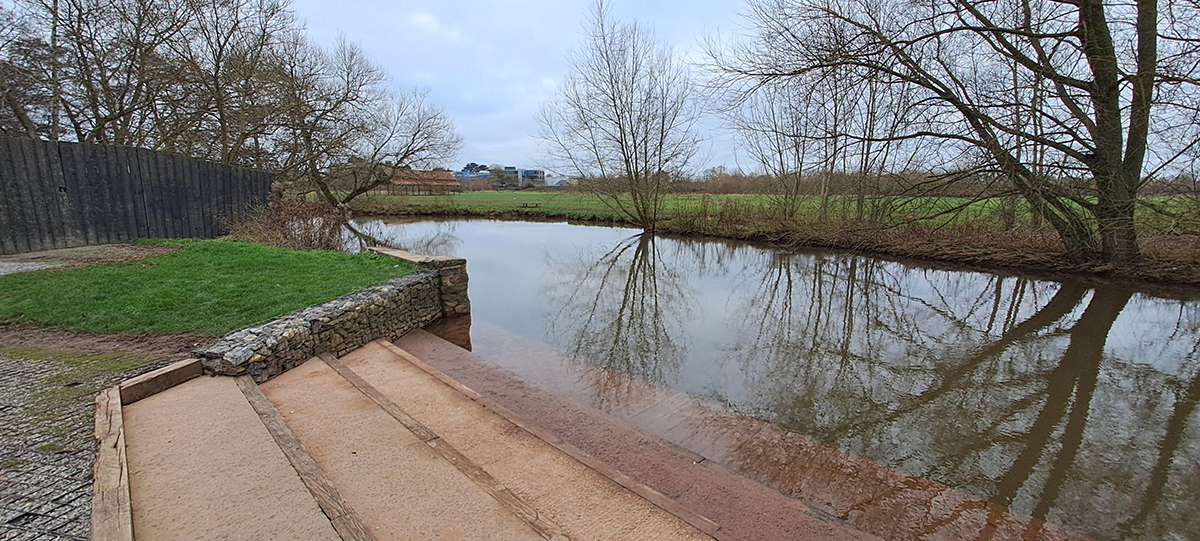
Visitors to a popular wild swimming and recreation site near Taunton can soon access near real-time water quality information.
Sensors linked to AI have been installed at French Weir to infer levels of river bacteria coming from numerous sources such as agricultural and wildlife activities.
The technology also enables Wessex Water to better assess any impact from licensed storm overflows, which can operate during or after intense rainfall to prevent flooding, as well as the company’s sewage treatment processes.
Sensors predict water quality every hour, with results shown on the Water Quality Live webpage as notifications to help swimmers, paddleboarders and others make an informed choice before entering the river.
French Weir became a designated bathing water site in 2024 and is monitored by the Environment Agency (EA).
Wessex Water is part of an EA-led Bathing Water Steering Group that is working collaboratively with interested parties with the aim of improving river water quality for newly-designated bathing water locations.
Between now and 2030, in-river sensors are being installed and machine learning algorithms are being trained at other popular spots across Somerset, Wiltshire, Dorset and South Gloucestershire.
Ruth Barden, Wessex Water’s Environmental Solutions Director, said: “There will always be bacteria in rivers, whether it has come from natural or human activities, but that shouldn’t mean they are no-go areas for swimming or recreation.
“Water quality varies and is typically better during dry weather, when there is less run-off from the land and storm overflows are less likely to discharge rainwater or groundwater.
“The safety of swimming and recreation at specific locations is for councils and others to determine, but we want to help people make an informed choice by delivering near real-time water quality information using AI at popular coastal and inland sites.
“Over the next five years we’ll be making unprecedented investment in sealing drains and sewers, nature-based solutions for sewage treatment, nutrient removal and rainwater storage to further improve river health.”
Taunton and Wellington MP Gideon Amos said: “The reason I worked on and submitted the application for Bathing Water Status for our River Tone in Taunton was to get real action on cleaning up the state of our rivers.
“So, I want to say a huge thank you to Wessex Water and all the other members of the Steering Group who I’ve been working with since winning the designation, for this new real-time water monitoring system.
“Having the right information is the vital first step in planning what investment is needed. Once up and running, you’ll be able to see the quality of the river water right at the very moment you want to go boating or even take a dip.”
Traditional samples collected by hand and analysed under controlled conditions can take too long to inform water users of actual risk levels, while Water Quality Live provides near real-time water quality information.
The alerts and any related data do not constitute a definitive assessment of water quality at a given time, so it is the responsibility of the user to consider whether the water is safe to enter.
Since no technology can continuously measure the concentration of these bacteria, the solution has been developed to utilise readily available sensors that provide robust real-time measurements of other water quality indicators, including temperature, pH, conductivity, dissolved oxygen and river flow.
Information from the sensors and lab samples is used to train algorithms to predict the bacteria levels at bathing locations all year round.
It can take between 12 and 24 months to train the algorithms used to predict bacteria levels, depending on the amount of data necessary and the complexity of the catchment area.