



The next generation of water treatment will be defined by combinations of advanced technologies. The companies that move early to support those innovations will secure the advantage.
Richard Bruges, Chief Executive, Salinity Solutions
The water sector is being asked to deliver outcomes that conventional treatment trains were not designed to achieve. Step-changes in performance are required and will come from combining genuinely innovative, complementary technologies rather than refining existing systems. Early adopters will gain advantage by securing access to technologies and developing them into scalable solutions.
A new perspective
For the past thirty years, progress in water treatment using membranes has been driven by continuous improvement. Membranes have become more efficient, pumps more reliable, controls smarter and engineering teams better at integrating proven equipment. That work remains essential. But the engagement we are now seeing across industrial water reuse, municipal reuse and Zero Liquid Discharge (ZLD) suggests that incremental gains alone will not meet future requirements.
Operators increasingly want to recover 90% to 98% of the water in difficult streams, creating resilient supplies from water that was previously treated as waste, while lowering energy and chemical use and reducing volumes requiring final disposal. In commercially demanding applications, a two or three per cent performance improvement is useful, but it rarely changes the investment decision. Improvements of 30% to 50% in cost or performance can change the design, the economics and, ultimately, whether a project proceeds.
That distinction matters. The market is not simply asking for a better version of yesterday’s plant. It is asking for a different treatment approach, capable of meeting water scarcity, industrial growth and tighter discharge requirements at the same time.
Priorities are changing
In our conversations with end customers and delivery partners, the emphasis has moved decisively towards recovery, reuse and the cost of managing concentrate. This is particularly visible in India, where Zero Liquid Discharge, or ZLD, has become a practical operating requirement for many water-intensive industries. India’s regulator-led framework, including Central Pollution Control Board directions and National Green Tribunal orders, has pushed sectors such as automotive, distilleries, textile dyeing and processing, tanneries, and pulp and paper towards ZLD where high-strength or high-salinity effluent creates significant environmental risk. India is not only a large market for ZLD; it is becoming an innovation laboratory in which new combinations can be tested against real industrial constraints.
A similar shift is now visible in North America. The United States Environmental Protection Agency frames industrial reuse as covering municipal recycled water for manufacturing and data centre cooling, as well as water generated and reused within sectors such as microchip manufacturing, food and beverage, mineral extraction and energy. Its Water Reuse Action Plan funding resource brings together support from several federal agencies, including the Environmental Protection Agency, Department of Energy and Department of the Interior. For technology developers and engineering partners, these programmes create opportunities for demonstration, validation and reference projects, not just research funding.
This is a significant change. Reuse is shifting from a sustainability measure to a critical enabler of production capacity, resilience and regional growth.
Data centres turn water into a strategic constraint
Artificial intelligence growth has focused attention on electricity demand, but water is becoming an equally important constraint. Data centres use water directly in cooling and indirectly through the power system and in the hardware supply chain. The Environmental Protection Agency now includes data centre cooling explicitly within its industrial water reuse resources. As clusters grow, developers need to consider where water comes from, how often it can be recycled, what is discharged and how demand affects local communities.
The scale of the issue is already significant. Global data centre water consumption has been estimated at around 560 billion litres in 2023 and could more than double by 2030. A single 100 MW data centre can require around 2 million litres of water per day, meanwhile the UK is already projected to face a water deficit of nearly 5 billion litres per day by 2050. In that context, water reuse is not simply a sustainability measure; it is becoming a condition of growth.
This creates a clear opening for advanced treatment systems. The opportunity is not limited to polishing municipal recycled water. It includes increasing cooling tower cycles of concentration, recovering blowdown, treating difficult on-site streams and reducing the liquid volume passed to costly final treatment. The winning solutions will be those that combine reliability with a lower whole life cost and can be replicated across a portfolio of sites.
ZLD is exposing the limits of conventional systems 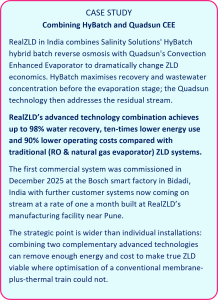
ZLD aims to recover water and leave no liquid waste for discharge. Conventional ZLD systems can do this but depend heavily on thermal evaporation after initial membrane concentration. Energy, scaling, fouling and disposal of residual solids can make the economics difficult.
Our observation from India is that the decisive question is no longer whether a single unit operation can be improved. It is shifting towards identifying whole new processes to dramatically increase water recovery while driving down energy and other operating costs (see adjacent case study).
New technology stacks
Salinity Solutions’ HyBatch™ is one example of this new generation of technologies. Hybrid batch reverse osmosis (RO) delivers higher recovery with up to 50% less energy than conventional systems.
At Béziers in southern France, SUEZ has launched a 100 cubic metre per day HyBatch pilot for municipal wastewater reuse. SUEZ reports recovery of 90% to 95%, compared with a maximum of 85% for comparable conventional RO, while also minimising chemicals and energy use.
Engagement with Xylem points to another set of applications with the same commercial logic. Salinity Solutions joined the Xylem Innovation Labs Partnerships Accelerator in 2026, to explore deployment of HyBatch in areas including ZLD, industrial process water, oil and gas and mining. It is an example of an EPC engaging early with a specialist technology developer to test both technical performance and routes to market.
Meanwhile, other innovators are attacking adjacent constraints. ZwitterCo’s Zwitterionic membranes are designed for highly organic and fouling-prone wastewater, helping engineering partners treat streams that challenge traditional filtration. Membrion’s electro-ceramic desalination selectively removes dissolved salts and metals from difficult industrial wastewater, with applications in semiconductors, metal finishing, food and beverage, reuse and ZLD strategies.
Beyond membranes, companies are attacking different parts of the same problem. Global Cavitation’s hydrodynamic cavitation and nanobubble systems target gas transfer, oxidation, flotation and pre-treatment. Valence Water’s modular electrocoagulation and electro-oxidation systems can remove fouling loads ahead of concentration. Gradiant H+E’s AquaCritox targets PFAS destruction in industrial wastewater. These are not interchangeable products; each can remove a different bottleneck within an integrated treatment train.
The result is an emerging technology stack: fouling-resistant pre-treatment, selective ion removal, high-recovery membrane concentration, efficient evaporation, advanced controls and, where relevant, resource recovery. No single technology needs to solve every problem. The system needs to combine the right technologies so that each operates where it creates the most value.
Why this matters for large engineering companies
For EPCs, this creates both an opportunity and a threat. Scale, delivery strength, procurement and balance-sheet credibility remain decisive, but they do not by themselves create a 30%+ cost or performance advantage that decisively changes the competitive offering. If two bidders can both build a reliable plant, the bidder with access to a differentiated technology stack can offer significantly higher recovery, lower energy, smaller footprint or less waste.
That advantage compounds. A better process can reduce the size and cost of downstream equipment, lower power infrastructure requirements and improve the customer’s regulatory compliance. It can also win projects that would otherwise fail the customer’s investment hurdle. Advanced technology is not simply another item on the bill of materials. It offers significant competitive advantage, increasing revenue, gross margin and net profit.
The strategic value of rights and exclusivity
If a breakthrough technology is available on identical terms to multiple operators, its benefit soon becomes part of the market baseline. If an EPC secures exclusive or preferential rights in a clearly defined field, application or geography, the same technology can create defensible differentiation.
This does not mean granting broad exclusivity at any price. The strongest arrangements align incentives: the technology developer receives funding, market access, engineering support and a credible path to scale, while the larger partner receives protected access in markets where it will invest and build demand. Clear milestones, minimum commitments and defined boundaries are essential so that exclusivity accelerates deployment rather than restricting it.
We are therefore likely to see more licensing, co-development, strategic investment and field-specific exclusivity across advanced water treatment. For major EPCs, the question will increasingly be whether to wait until a technology is fully validated, or engage early enough to shape it, prove it and secure an advantage before competitors do. The winners are likely to be those with the flexibility to engage early with the most promising technology combinations and accelerate their development.
Conclusion: from components to outcomes
Continuous improvement will always matter in water engineering, but it is no longer enough on its own. Reuse, data centre growth and ZLD are creating requirements that call for step-change improvements measured in tens of percentage points rather than single digits.
Based on the engagement we are seeing, is that the next generation of water infrastructure will be defined by intelligent combinations of advanced technologies. The winners will be the companies that can identify complementary innovations, integrate them into reliable systems and use commercial partnerships to scale them quickly.
The strongest competitive advantage will come from moving early: securing access to the right technologies, providing the investment, engineering support and market access that help them scale, and turning those combinations into outcomes that customers cannot achieve through conventional systems alone.
Sources and further reading
- Salinity Solutions, HyBatch technology and performance: https://salinitysolutions.co.uk/
- SUEZ, Béziers hybrid batch reverse osmosis pilot, 24 April 2026: https://www.suez.com/en/news/press-releases/suez-salinity-pilot-reverse-osmosis-municipal-wastewater-reuse
- India Zero Liquid Discharge regulation, Central Pollution Control Board and National Green Tribunal requirements: Central Pollution Control Board directions and related National Green Tribunal orders covering high-risk industrial sectors including distilleries, textile dyeing and processing, tanneries, and pulp and paper.
- Salinity Solutions, Xylem Innovation Labs 2026 cohort announcement: https://www.linkedin.com/posts/salinity-solutions_xylem-letssolvewater-water-activity-7445462674882252800-mPOV
- RealZLD, combined HyBatch and Quadsun technology: https://www.realzld.com/
- US Environmental Protection Agency, industrial water reuse resources: https://www.epa.gov/waterreuse/water-reuse-industrial-applications-resources
- US Environmental Protection Agency, water reuse funding programmes: https://www.epa.gov/waterreuse/water-reuse-infrastructure-funding-programs
- US Bureau of Reclamation, Large-Scale Water Recycling Program: https://www.usbr.gov/watersmart/largescale/index.html
- ZwitterCo, systems for difficult industrial wastewater: https://zwitterco.com/zwitterco-systems/
- Membrion, electro-ceramic desalination for industrial wastewater: https://membrion.com/
- Global Cavitation, hydrodynamic cavitation and nanobubble systems for industrial wastewater: https://globalcavitation.com/industries-overview/industrial-wastewater/
- Global Water Intelligence, Gradiant H+E AquaCritox supercritical water oxidation: https://waveep.com/gradiant-awarded-water-company-of-the-year-by-global-water-intelligence/
- Valence Water, modular electrocoagulation and electro-oxidation systems: https://valencewater.com/
About the author
Richard Bruges is Chief Executive of Salinity Solutions. He holds a Bachelor of Science in Mechanical Engineering from the University of Edinburgh and a Master of Business Administration from London Business School. His perspective draws on early experience in the automotive sector, a career in product development, more than fifteen years supporting early-stage engineering companies, and five years steering Salinity Solutions from university spin-out to commercial maturity.