



In water distribution networks, reliable, high-quality data is the foundation of effective digital management.
District Metered Areas (DMAs) underpin every Non-Revenue Water (NRW) reduction strategy, yet their success depends on continuous, accurate flow and pressure data. For decades, utilities have relied on battery-powered or grid-connected meters that only capture intermittent readings, leaving gaps that weaken digitalisation efforts and limit operational insight.
As utilities move towards real-time management, predictive models, and digital twins, the challenge is clear: how to obtain high-frequency, dependable data across an entire DMA without increasing maintenance requirements or cost.
The Challenge: Power and Data Limitations in Traditional Flow Monitoring
Traditional monitoring technologies struggle with a long-standing trade-off between data frequency and energy consumption. Battery-powered meters are simple to install but must restrict their measurement intervals to preserve battery life. True real-time data would drain batteries within days, and replacements can cost up to €6,000 per unit per year once technician time, travel, and disposal are included. Grid-powered systems face bureaucratic hurdles, delays in approval, and significant installation costs. Solar-powered setups introduce their own limitations—requiring exposure, regular cleaning, and resilience to weather and vandalism.
These constraints lead to delayed, fragmented, or low-resolution data. Early signs of leakage, pressure transients, or pipe fatigue may go unnoticed. Without continuous data, leak detection algorithms, hydraulic models, and predictive tools cannot perform reliably. The result is a persistent disconnect between digital ambitions and the practical realities of powering sensor networks.
The Turning Point: Energy Harvesting at the Point of Flow
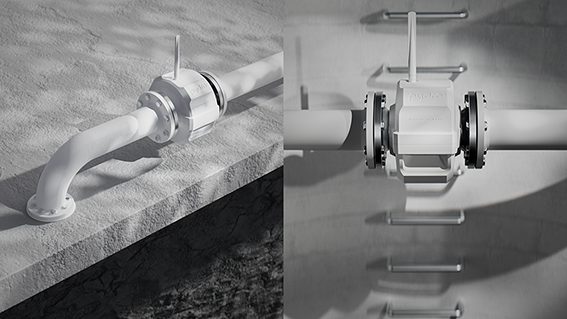
PYDRO’s PT-1 flowmeter addresses this problem by harvesting energy directly from the water flow. This eliminates dependency on external power sources or batteries, allowing continuous, minute-level data transmission. The PT-1 is a self-powered, IP68-rated smart turbine flowmeter measuring flow, pressure, and temperature with OIML Class II accuracy, suitable even for flooded or remote chambers.
An internal hydro-turbine converts the kinetic energy of moving water into electrical power, charging a backup battery for periods of low flow. With integrated LTE Cat M1, NB-IoT, and 2G connectivity, the PT-1 transmits encrypted data directly to cloud platforms or SCADA systems without external loggers or SIM management. Once installed, it operates autonomously, providing a genuine “fit-and-forget” solution.
The Impact: Real-Time DMA Intelligence at Lower Cost
Permanent, high-resolution data fundamentally changes operational capability. With minute-by-minute flow and pressure readings, utilities can detect micro-leaks and anomalies far earlier, improving service continuity and reducing the likelihood of bursts. This granularity enhances the performance of digital twins and analytics tools, enabling more accurate modelling and proactive asset management.
The cost advantages are significant. Over a ten-year life cycle, removing the need for battery replacements reduces total cost of ownership by over 70% compared with battery-powered alternatives. Grid or solar-powered systems—often requiring trenching, cabling, and repeated on-site work—can cost up to ten times more to deploy. PYDRO’s design offers an install-ready, plug-and-play solution that delivers immediate data from existing DMA chambers.
From Data Gaps to Data Continuity
As utilities across Europe pursue digital water strategies and ambitious NRW targets, continuous data coverage becomes essential. The PT-1 provides this continuity without adding operational burden, supporting the transition from periodic measurement to permanent insight. Pilots across Italy, Greece, and Northern Europe have shown that real-time visibility can cut leak runtimes by up to 40% and reduce operational expenditure by 30%, while improving repair coordination and response time.
Enabling a Sustainable Digital Water Future
The PT-1 is more than an incremental improvement—it is a catalyst for large-scale digitalisation. By uniting sensing, communication, and energy harvesting in one device, it bridges the gap between physical infrastructure and digital intelligence. It enables DMAs to function as self-powered data nodes, driving the next generation of water management.
In a sector where every litre and every euro matters, turning water’s own energy into continuous, actionable intelligence is not only innovative—it is essential for building efficient, resilient, and sustainable water networks.
pydro.com