




Leakage has moved beyond being a technical performance metric. It is a financial liability, a regulatory risk, and a reputationcal issue that boards can no longer treat as background noise.
Around 20 per cent of treated water in England and Wales is still lost before it reaches customers. At the same time, companies face stretching Ofwat targets, material ODI exposure and public criticism whenever restrictions are introduced.
The contradiction is obvious. Customers are asked to reduce consumption while significant volumes disappear underground. Every litre lost has already been abstracted, treated and pumped at cost. Leakage is wasted energy, chemicals, and capital.
The industry has invested heavily in active leakage control, district metered areas, correlators and acoustic logging. These methods remain part of the toolkit. But they are not always reliable on modern plastic networks, in high-noise urban environments or on low-pressure service connections.
Background interference, intermittent leaks and complex fittings reduce confidence. Too often, excavation becomes the only way to confirm what is happening. That approach drives costs and disruption and exposes companies to performance risk if leaks are mislocated or slow to resolve.
A more direct method is needed, one that provides evidence from inside the live asset rather than inference from above ground.
Synthotech’s in-pipe inspection and acoustic systems are designed to deliver that level of certainty.
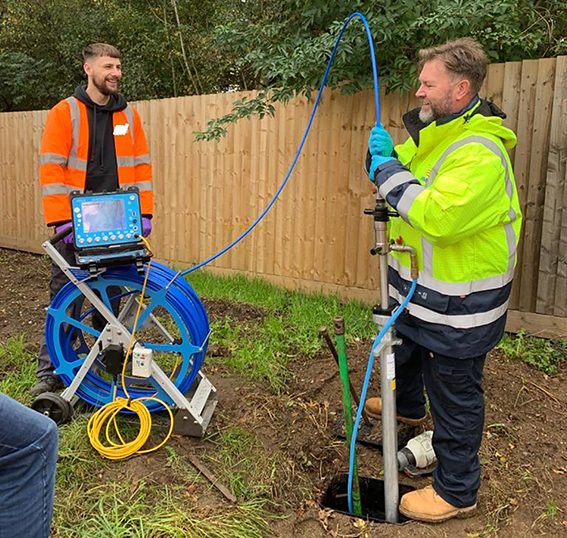
The PipeMic® FLEX-V2 is an in-pipe acoustic leak detection system for pressurised live-service pipes. Instead of relying on surface listening, engineers insert a 4.5mm ultra-flexible rod fitted with an acoustic sensor directly into the pipe. The flexible tip can negotiate bends in 25mm pipe, a common feature in service layouts.
The system operates at pressures ranging from 1 bar to 10 bar and uses WRAS compliant material. Once deployed, the operator can hear the leak internally and use standard tracing equipment to pinpoint the exact location. In practice, this reduces unnecessary excavations and improves first-pass accuracy for small-diameter assets, where traditional techniques often struggle.
On larger mains, the operational and financial stakes increase. Traffic management, customer impact and reinstatement costs mean each excavation must be justified.
The SynthoCAM H2O system provides live access CCTV inspection with an integrated microphone for potable water mains. Accessed through a through-bore hydrant or 80mm valve and deployed via a pressure-balanced insertion tube rated to 10 bar, it allows inspection without taking the main out of service.
Interchangeable 30mm and 46mm cameras cover diameters from 4 inch to 10 inch, and surveys of up to 200 metres can be completed from a single excavation. Operators can see internal conditions and hear leakage at the same time, while integrated sonde capability supports accurate location. This enables confirmation of the defect position and informed decisions on repair scope before further ground is broken.
For service connections, the ServiceCAM H2O-LTE offers live CCTV inspection for pipes between 25mm and 55mm diameter at pressures up to 10 bar. It can be deployed via the boundary box, reducing the need for disconnection. Designed for single-person operation, it reduces on-site time and provides clear information on pipe material, joint location, and internal condition.
The commercial implications are clear. Better location accuracy reduces wasted digs, and faster confirmation shortens repair cycles. Clearer asset intelligence supports targeted interventions, which in turn reduce operational expenditure and improve performance against regulatory commitments.
Leakage reduction targets will continue to tighten. Public tolerance for visible failure is already low. In that context, relying solely on indirect detection methods is increasingly difficult to justify.
In-pipe inspection and acoustic verification provide a practical route to greater certainty. They allow engineers to diagnose from within, reduce unnecessary disruption and protect performance metrics that carry direct financial consequences.
For water companies looking to control costs, meet regulatory expectations and restore confidence, internal intelligence should not be viewed as a specialist option. It should form part of standard leakage practice.
synthotech.com