




Practical approaches to reducing actuator failures and improving asset availability
Colin Borrows, Head of Sales, AUMA Actuators Limited
At wastewater treatment works, actuated inlet penstocks are among the most critical mechanical assets. As the first control point for incoming flow, failure of either the penstock or its actuator can disrupt the entire treatment process.
Although maintenance often focuses on the actuator, many reliability issues originate at the mechanical interface between the actuator and the penstock spindle. Understanding how these components wear and adopting targeted maintenance practices can significantly improve asset availability while reducing unplanned downtime.
Understanding the thrust base
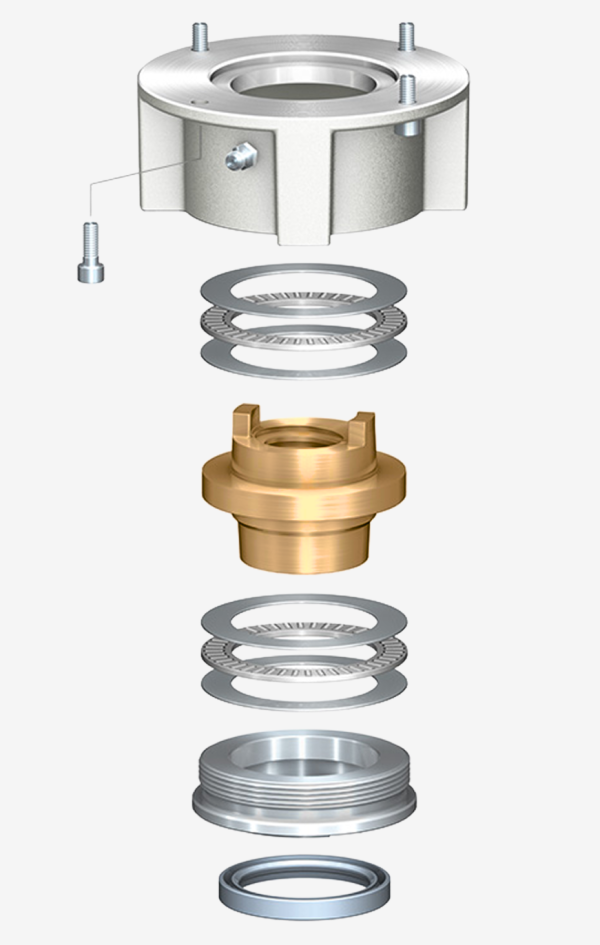
The connection between an electric actuator and a rising-spindle penstock is made through the thrust base, which contains bearings, a drive sleeve, grease seals, lubrication points and a drivenut.
The drivenut converts the actuator’s rotary movement into the linear motion required to operate the penstock. Manufactured from phosphor bronze, it is deliberately softer than the stainless-steel spindle, acting as a sacrificial component that protects the more expensive spindle from wear.
Drivenut wear is therefore expected during normal operation rather than an indication of failure. However, excessive wear can eventually result in thread slip or complete loss of engagement, making regular inspection an essential part of preventative maintenance.
Preventing premature failure
Thread wear is only one cause of reliability problems. Thrust bearings are equally vulnerable if water enters the assembly. Damaged cover tubes or missing end caps can allow rainwater to wash away lubricant, accelerating wear and increasing operating torque.
Rising torque can provide an early warning of bearing deterioration, inadequate lubrication or increasing friction within the drivenut assembly. Identifying these changes before failure develops allows maintenance to be planned rather than reactive.
Several straightforward measures help extend service life. Accurate machining during installation, maintaining effective lubrication of both the spindle and drivenut, preventing dirt and water ingress, and ensuring the penstock itself remains in good mechanical condition all contribute to reducing wear. Where appropriate, extending the drivenut increases thread engagement, distributing wear over a greater surface area and prolonging component life.
Lubrication matters
Lubrication remains one of the simplest yet most effective maintenance activities. However, lubricating the thrust bearings does not normally lubricate the spindle thread, which usually requires removal of the cover tube before grease can be applied directly.
Where regular maintenance is difficult, automatic lubrication systems provide a practical alternative. By modifying the drivenut, lubricant can be delivered simultaneously to both the thrust bearings and spindle thread, improving protection while reducing maintenance requirements.
The cover tube also plays a vital role by preventing dirt, grit and rainwater from reaching the spindle and thrust base. Routine inspection and prompt replacement of damaged tubes helps preserve lubrication and protect both bearings and drivenut from premature deterioration.
A condition-based approach
Modern electric actuators generally require relatively little routine maintenance, so inspections should focus on the associated mechanical components. Routine checks should confirm the condition of the cover tube, verify lubrication, monitor drivenut wear and review actuator fault logs for repeated torque trips that may indicate developing issues within the penstock or spindle.
Rather than relying solely on fixed maintenance intervals, inspection frequency should reflect how frequently an asset operates and the conditions in which it works. Holding pre-machined replacement drivenuts in stock can also reduce downtime when replacement becomes necessary.
Many modern actuators also incorporate asset management functions that record operating history and fault events. Analysing this operational data enables maintenance teams to identify emerging issues earlier and move towards a more condition-based maintenance strategy.
Standardisation delivers efficiencies
Alongside effective maintenance, standardising actuator assets can simplify management across treatment sites. A common actuator platform reduces spare parts inventory, simplifies installation and retrofit projects, minimises training requirements and improves equipment availability.
Reliable inlet penstocks are fundamental to the efficient operation of wastewater treatment works. While the actuator often attracts most attention, long-term reliability frequently depends on maintaining the mechanical interface between the actuator and the penstock.
Recognising the drivenut as a consumable component, maintaining effective lubrication, preventing water ingress, monitoring operational data and adopting a considered approach to standardisation can help water companies improve asset reliability, reduce downtime and support more efficient management of critical inlet works infrastructure.
More information at auma.co.uk