



Reducing leakage is one of the biggest operational challenges facing the UK water industry. While finding and repairing leaks remains essential, preventing unnecessary stresses on the network also has an important part to play.
In England alone, water companies reported leakage of 2,617 million litres per day in 2024/25 – equivalent to around 19% of the water put into supply. Although this was the lowest level recorded for more than 20 years, the scale of the loss demonstrates why leakage remains such an important issue for the industry.
Ofwat has set companies in England and Wales targets representing a further 17% reduction in leakage between 2024/25 and 2029/30. Longer term, the industry has committed to halving leakage from 2017/18 levels by 2050.
Meeting those targets requires more than detecting and repairing leaks after they occur. Pressure management, asset renewal and reducing pressure transients can all contribute to managing leakage and reducing stresses on water infrastructure.
One potentially important element of this approach is sympathetic valve control using variable speed electric actuators.
The relationship between pressure and leakage
Changes in flow caused by the operation of pumps and valves can generate pressure transients within water distribution networks. The way a valve is operated matters.
A conventional fixed-speed electric actuator moves at a predetermined speed. Variable speed electric actuation provides greater flexibility, enabling the speed of valve movement to be adapted to the requirements of the process.
Instead of opening or closing at one speed throughout its travel, a valve can, where the application requires it, be operated more gradually during critical parts of the cycle.
Colin Borrows, UK Head of Sales, AUMA Actuators Limited says: “Leakage reduction isn’t only about finding water once it is escaping from the network. There is also a preventative element – looking at how assets are operated and how to minimise unnecessary stresses on the infrastructure.
“Sympathetic control gives engineers much greater control over how a valve moves. Using variable speed actuation to manage opening and closing more carefully can help reduce sudden changes in flow and pressure and mitigate the risk of damaging pressure transients. It is one of the tools water companies can use as part of a wider approach to pressure management, leakage reduction and asset protection.”
Creating calmer networks
There is established industry evidence for the relationship between network pressure, pressure surges and leakage. Water UK’s Leakage Routemap to 2050 identifies pressure as one of the factors influencing leakage. Water distribution networks have to remain pressurised to deliver the required service, but higher pressures and pressure surges can contribute to leakage over time. The Routemap also identifies ground movement and stresses placed on infrastructure as factors influencing leakage.
Ofwat similarly identifies operational strategies, including pressure management, alongside pipe condition and network characteristics as factors affecting leakage. This matters because pressure transients are not simply an issue associated with major pipe bursts. Repeated changes in hydraulic conditions can impose additional stresses on pipes, joints, valves and other network assets. Managing the way equipment operates is one element of a broader strategy for reducing unnecessary stresses on the network.
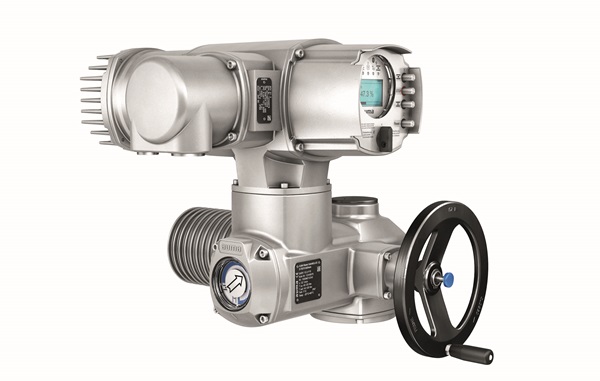
AUMA’s variable speed electric actuator technology enables operating speed to be adapted during valve movement. AUMA SAV and SARV actuator ranges provide variable speed solutions for larger applications, while AUMA’s compact PROFOX range brings variable speed operation to smaller valves.
AUMA SARV actuators, for example, provide soft start and stop functionality for gentle valve operation and allow speed profiles to be configured to help avoid pressure surges.
This distinction is important. Variable speed actuation does not itself prevent leakage, nor can it eliminate water hammer. Hydraulic behaviour depends on the characteristics and operating conditions of the complete system. What variable speed technology can provide is greater control over one of the factors capable of influencing hydraulic behaviour: how quickly a valve changes the flow through the network.
By controlling acceleration, operating speed and deceleration where appropriate, engineers have greater scope to tailor valve movement to the hydraulic characteristics of the application rather than accepting a single fixed operating speed.
From major assets to compact valves
The same principle can be applied across different scales of infrastructure. At Thames Water’s Beckton Sewage Treatment Works, for example, AUMA SAV variable speed actuators have been installed on 12 large penstocks. The project required a “sympathetic” approach to the existing assets. Variable speed operation allows the heavy penstocks to start and stop gently, reducing mechanical shocks, while higher speeds can be used during their long travel where appropriate.
For smaller automated valves, AUMA’s PROFOX range applies variable speed technology in a compact actuator platform. This enables the principle of controlled valve movement to be considered across a wider range of water and wastewater applications.
The significance is not simply the physical size of the actuator. It is the ability to select operating characteristics appropriate to the valve, process and wider hydraulic system.
Leakage reduction starts with the whole network
There is no single technology capable of solving the leakage challenge. Networks contain hundreds of thousands of kilometres of pipework of different ages, materials and operating conditions. Ofwat notes that leakage is influenced by asset condition, network characteristics and operational strategies including pressure management.
But with around a fifth of water running through pipes in England and Wales still being lost through leakage, every appropriate opportunity to reduce unnecessary stress on the network deserves consideration.
Sympathetic valve control changes the question from simply “Can we open and close this valve?” to “How should we open and close it?”
Used as part of a properly engineered pressure-management and leakage-reduction strategy, variable speed electric actuation can help water companies manage valve movement more carefully, mitigate pressure transients and protect existing infrastructure – contributing to calmer, more resilient networks and the industry’s wider efforts to reduce leakage.