




The UK water industry is facing a defining moment. Mounting public pressure, increasing regulatory scrutiny and the growing impacts of climate change have converged to create an urgent need for transformation. Pollution incidents, storm overflow spills and deteriorating asset health are no longer isolated operational challenges, they have become national priorities with significant environmental, economic and reputational consequences.
At the same time, new regulatory frameworks and government‑driven expectations are reshaping the landscape. The Government’s ‘A New Vision for Water’ has ushered in a shift from reactive management to proactive environmental stewardship, and water companies are being pushed to deliver long‑term resilience, greater transparency, and measurable improvements in environmental performance.
In this changing environment, one message is becoming increasingly clear: the industry must move beyond piecemeal fixes and adopt integrated, catchment‑wide strategies that address the root causes of pollution.
A sector under pressure: Climate, urbanisation and public trust
Climate change is intensifying rainfall, increasing hydraulic stress on ageing wastewater networks. As urban areas expand, impermeable surfaces grow, placing further pressure on systems not designed for today’s population or weather patterns. These pressures have contributed to rising pollution incidents, greater reliance on storm overflows, and a rapid decline in public trust.
Regulators have responded with strengthened expectations. Outcome Delivery Incentives (ODIs), Price Control Deliverables (PCDs), the Storm Overflow Assessment Framework v2, and enhanced monitoring requirements under the Environment Act are pushing water companies to elevate both performance and transparency. Compliance alone is no longer enough, the industry is expected to demonstrate real environmental improvement, backed by robust evidence and independent assurance.
From compliance to transformation: The rise of data‑led decision‑making
A key theme emerging across regulatory guidance is the need for high‑quality data and robust insight. Despite widespread rollout of Event Duration Monitoring (EDM), the majority of wastewater networks remain unmonitored. This lack of visibility makes it difficult to understand network performance, assess asset condition or identify the real drivers of pollution.
New expectations around continuous water quality monitoring, MCERTS‑certified devices and improved environmental reporting are driving utilities toward richer, more comprehensive datasets.
However, data alone is not the solution. The true value lies in combining data with engineering intelligence and strategic consultancy to deliver actionable insight that can prioritise interventions, justify investment, and ensure compliance with emerging regulation.
Catchment thinking: Seeing the system as a whole
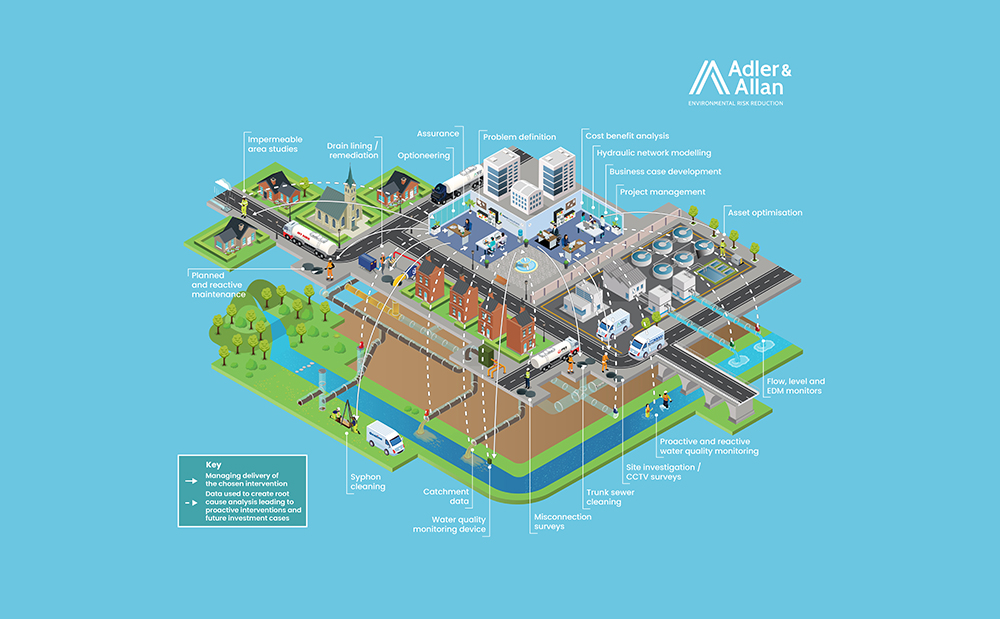
Central to Adler & Allan’s Solution to Pollution framework is the belief that pollution cannot be effectively reduced through isolated or reactive actions. Instead, water companies must adopt holistic, catchment‑wide strategies that consider the interconnected nature of assets, environmental receptors and operational practices.
Catchment‑wide approaches begin with robust problem definition:
- integrating data from flow monitors, water quality sensors, asset records and pollution response teams
- combining real‑time data with historical insight
- identifying misconnected properties, infiltration hotspots and hydraulic restrictions
- understanding how surface water interacts with the foul network
This allows utilities to develop a complete picture of system behaviour and pinpoint where interventions will have the greatest impact. Such insight is essential for targeted investment, whether that is cleaning and maintaining syphons and trunk sewers, sealing infiltration points, improving pumping capacity, optimising existing assets or enhancing monitoring coverage.
Conclusion: Turning insight into impact
The challenges facing the UK water industry require more than incremental improvement, they demand a strategic, integrated and data-driven approach that addresses root causes and builds long-term resilience.
A holistic catchment-wide strategy offers a clear path forward. By combining monitoring, insight, consultancy and targeted engineering, water companies can reduce pollution risk, improve environmental outcomes, and rebuild public trust. It is a proactive, prevention‑focused model that mirrors the future direction of the industry and prepares utilities for the next era of regulation, investment and environmental responsibility.