




As AMP8 begins, the UK water industry faces unprecedented expectations around environmental performance, cost-efficiency, and delivery certainty. To meet these goals, utilities and supply-chain partners are increasingly turning to standardisation and off-site construction as tools for improving asset reliability and reducing lifecycle costs.
Dutypoint, a UK manufacturer and systems integrator specialising in packaged pumping and wash water booster systems, is among those supporting this shift. Their work with water companies on the Better Rivers programme is now yielding framework-approved pumping stations and detention tank systems that offer proven performance and a clear path to consistent delivery.
Collaborating for Consistency
The Better Rivers initiative marks a major evolution in how combined sewer overflows (CSOs) and stormwater assets are designed and deployed. Rather than re-engineering systems for every site, water companies are embracing a “build once, use many times” model – producing validated designs that can be replicated at scale.
Working closely with water companies, Dutypoint has developed a suite of modular pumping station and detention tank designs, each configured to meet defined hydraulic, environmental, and resilience criteria.
“Standardisation isn’t about limiting design, it’s about building certainty,” says Tom Robertson, Water Industry Manager, Dutypoint. “By working with utilities and their framework contractors to create pre-approved, high-performance designs, we’re enabling faster delivery, safer builds, and more consistent operational performance.”
Each framework asset also supports digital integration, aligning with water companies’ ambitions for connected, data-driven infrastructure that simplifies maintenance and lifecycle optimisation.
Delivering Value through DfMA
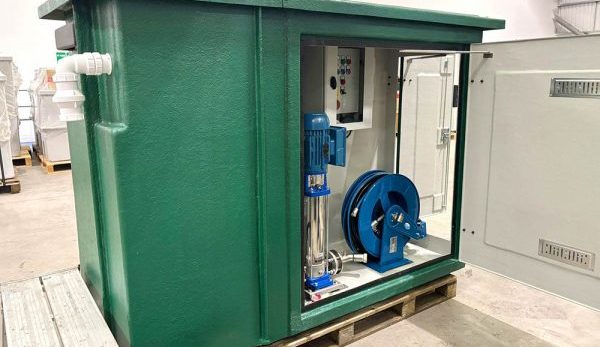
At the centre of this approach is Dutypoint’s Design for Manufacture and Assembly (DfMA) capability. Every packaged system, from chemical dosing units to below-ground pumping stations, is designed, assembled, and factory-tested at the company’s Gloucester facility before reaching site.
This controlled, off-site model brings measurable benefits:
Reduced on-site risk through fully tested, certified assemblies.
Installation times up to 50% shorter, accelerating programme delivery.
Consistent quality assurance, supported by repeatable, validated processes.
Lower whole-life costs, achieved through standardised maintenance and replacement.
These principles are already embedded in Dutypoint’s supply agreements with several water companies, where off-site DfMA systems have been adopted as standard assets. Discussions are now extending to further water utility companies and contractors as AMP8 planning progresses.
Extending Modularity Across Sectors
The same benefits of standardisation are now being realised in clean water and wastewater applications. Dutypoint’s factory-tested package pumping stations, chemical dosing kiosks and wash-water booster sets are being evaluated as potential standard products across several utilities. These designs combine consistent build quality with simplified installation and operation – key advantages in the delivery of an asset-heavy AMP period.
With full in-house design, fabrication, and testing capability, Dutypoint maintains control over product integrity while adapting systems to specific network conditions. In partnerships with Tier 1 contractors, these modular standards are being aligned across frameworks to create a consistent, repeatable national approach to asset delivery.
Partnership, Not Procurement
For AMP8 to succeed, collaboration must outweigh competition. Dutypoint works with utilities, consultants, and contractors from the earliest design stages to balance commercial, operational, and regulatory priorities.
“The sector is moving beyond procurement-led delivery,” says Tom Robertson. “We’re building long-term partnerships where shared innovation and data drives resilience and continuous improvement.”
This cooperative model underpins the industry’s shift towards an innovative, digital, DfMA-driven asset base—a foundation for delivering measurable value throughout AMP8.
Looking Ahead
With several framework awards secured and a growing library of validated standard assets, Dutypoint is entering its next phase: scaling DfMA deployment and refining modular designs to meet the needs of multiple stakeholders.
As utilities move through AMP8, the combined power of standardisation, collaboration, and digital readiness offers a clear route to greater resilience and affordability. Dutypoint’s approach illustrates how off-site manufacture and partnership-led delivery can help the industry achieve these goals—efficiently, consistently, and sustainably.
Find out more at dutypoint.com.