



United Utilities has reported another reduction in storm overflow operations across Cheshire over the past year, demonstrating further progress on its environmental commitments.
Official figures released by the Environment Agency (EA) have confirmed a 45% reduction in spill duration during 2025, with the number of spills from storm overflows falling by 33%.
At the same time, across the North West, the number of storm overflow activations has fallen by 22%, while the duration of spills reduced by 27%.
Across the region, storm overflow operations have now fallen for the past two consecutive years, delivering a combined 38% reduction in spills since 2023.
Chief executive Louise Beardmore said: “We’re pleased to show another year of progress in reducing storm overflows across Cheshire and the wider North West.
“The reductions we’re seeing are the result of the investment we’re making and the hard work of our teams delivering our biggest and most ambitious investment programme for over a century.”
The company has been delivering a wide range of improvements, including new storage tanks to capture and store wastewater during periods of heavy rain, upgrades to wastewater treatment works, and sustainable drainage solutions which divert rain run off out of sewers and into surface water drainage systems.
Other infrastructure improvements have included pipework upgrades and the use of AI and machine learning to identify issues such as blockages, so that proactive action can be taken before impacts occur.
In Cheshire, interventions have strengthened network performance, with improvements at 64 storm overflows preventing 808 activations in 2025. Interventions included the inspection and cleaning of 9,488 metres of sewer, which alone prevented 192 activations.
While drier weather contributed to reduced spills during the first half of 2025, rainfall over the full year was 101% of the historic average in the North West.
Louise added: “Our investment is making a real difference to towns, cities and local communities who want to see an improved and healthier environment for the region’s rivers, lakes and coastlines.
“We know there’s more to do. Customers have told us that reducing the use of storm overflows is something they care deeply about, and it remains a priority for us.”
United Utilities is investing more than £13.5 billion in the ‘Big North West Upgrade’ between 2025 and 2030. The programme will deliver new infrastructure, improve water quality, replace old water pipes, reduce leakage to its lowest ever level, and protect over 500km of rivers and bathing waters.
Good progress is already being made in the £48 investment to upgrade the sewer network across Cheshire and improve water quality in Knutsford.
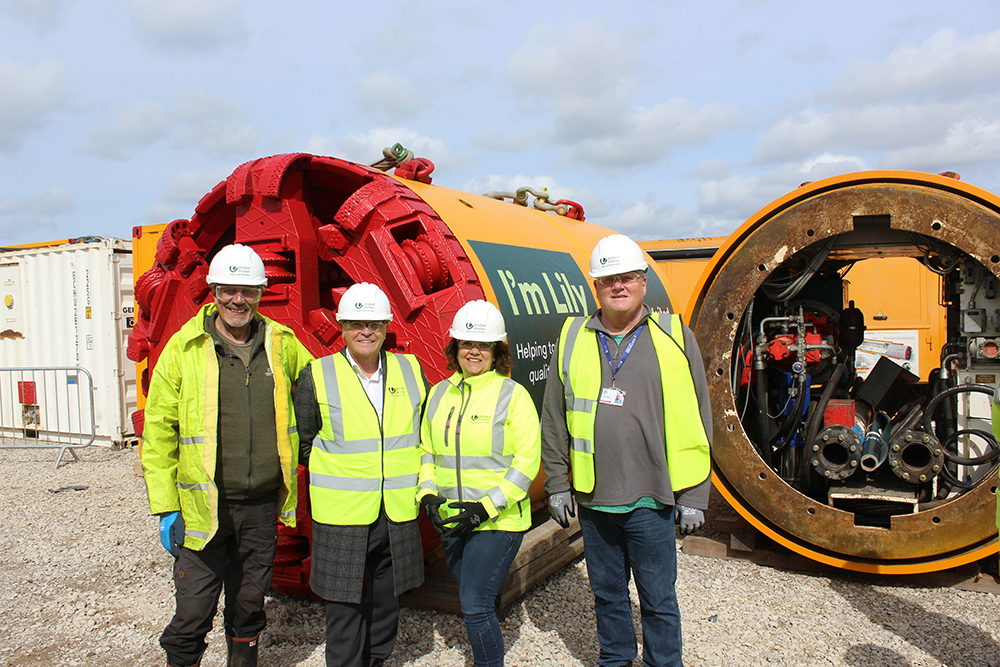
The local mayor and councillors recently visited the Parkgate Lane construction site in Knutsford to see the first phase of works to build a new stormwater tunnelling solution.
At 1.8km long, the tunnel will be up to 20 metres underground at its deepest point and will be able to store up to 5.5 million litres of stormwater during periods of heavy rainfall, before it is treated at Knutsford wastewater treatment works.
The councillors were also introduced to the tunnel boring machine, named ‘Lily’ by local school pupils after the local watercourse. They learned more about how the machine will carve the route for the new tunnel to the treatment works, as well as the precision engineering required to complete the project by mid2027.
The second phase of the project includes a partnership approach with Natural England and Tatton Estates to remove a century’s worth of sediment build up in the Pool.
To safely complete this work, a fish rehoming exercise has been carried out at Moor Pool. Specialist contractors safely netted and transferred 19 pike, 24 bream, one carp and large numbers of roach and perch further upstream in Peover, enabling essential work to be carried out to remove builtup sediment.
Jane Simpson, United Utilities’ Commercial Engineering and Capital Delivery Director, said that removing the sediment will help restore the pool’s health, improve water quality and protect the wildlife that depends on it. Once the works are complete, fish will naturally repopulate Moor Pool from downstream near Middle Pool.
She added: “This project highlights our ongoing commitment to improving water quality in the county and shows how working closely with partners can deliver innovative solutions to stormwater management in protected areas.
“Once complete, the scheme will be able to store up to 5.5 million litres of stormwater during heavy rainfall — the equivalent of two Olympicsized swimming pools.”