



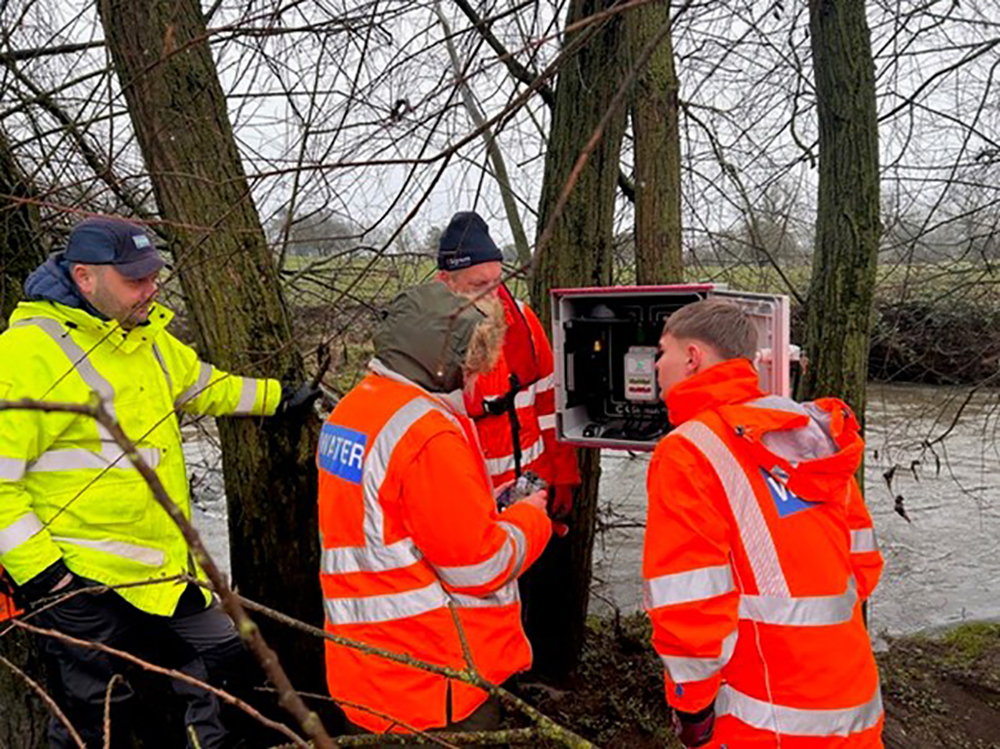
Severn Trent and several delivery partners have carried out fieldwork trials focused on solving deployment issues in complex catchment areas.
The focus wasn’t on technology, but how to tackle the challenges and deploy safely within a few hours, across difficult environments such as:
Bridge-mounted deployments
Steep and constrained riverbanks
Use of a portable mini-davit system, aligned with STW hazard and operational requirements
The collaboration involved the team from Severn Trent Water’s Section 82 Continuous Water Quality Monitoring programme, alongside estates, ecology, and delivery partners BGEN, Ovarro and CEMA at a site in Ilkeston.
A team from wireless underwater communications specialist, CSignum, was also on site to demonstrate its wireless river monitoring system.
Collective feedback was clear – a wireless approach solves several challenges:
Predictable site costs, avoiding expensive civils and engineering unknowns
Minimal environmental impact with rapid deployment, typically operational within hours
Suitable for flood-risk locations, with gateways positioned safely above river level
Ideal solution for areas with high footfall/public locations or areas at risk of vandalism, as the topside gateway can be located discreetly up to 100m away and out of sight
Effective for deployment in urban locations or rivers with steep or concrete banks/channels
Portable system that can be relocated as monitoring needs change
Ideal for bathing water SSSI/UNESCO sites and where visible infrastructure is undesirable
Suitable for wide or fast-flowing rivers (deployable with anchor mounting system) including bridge-mounted deployments
Ability to support clustered CSO monitoring points utilising a single Gateway where proximity permits
This deployment consisted of:
An EM-2Q riverbed assembly, integrating an EM-2 modem and Xylem EXO2s sonde
An EM-2G topside gateway, with EM-2 modem and telemetry unit
The gateway can be located up to 100m from each riverbed system, enabling flexible, low-impact deployments and complete upstream and downstream CSO monitoring.
A CSignum spokesman thanked Severn Trent Water and partners for the open discussion, and said they looked forward to continue working together to tackle challenging catchments as one team.