




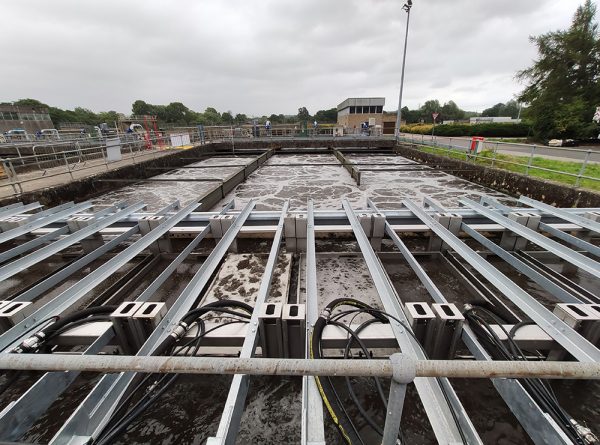
Severn Trent’s Monkmoor Sewage Treatment Works in Shropshire has received a significant upgrade to support Shrewsbury’s growing population and support the company’s carbon reduction ambitions.
The £6.2 million project involved the installation of cutting-edge Membrane Aerated Biofilm Reactor (MABR) technology to the wastewater treatment process.
Unlike traditional wastewater treatment, which requires a constant supply of oxygen to support bacteria that are an essential part of the process, MABR uses special membranes that oxygenate the water.
This unique, ‘bubble-less’ aeration method has proven to be highly effective at supporting bacteria during MABR’s initial trial at Severn Trent’s Resource Recovery Innovation Centre (R2IC) in Warwickshire.
The R2IC was built at the company’s Spernal Sewage Treatment Works and uses a ‘plug and play’ approach to test and trial technologies. The site offers opportunities for third parties such as SMEs and universities to test innovations at a live treatment works.
Alongside reducing the amount of energy needed to treat wastewater, the MABR system was also found to be more energy efficient, cleaner and quieter.
The installation at Monkmoor is the first large-scale deployment of the MABR units, marking a significant milestone in Severn Trent’s ambition to improve the wastewater treatment process and lower its carbon impacts.
Clair Green, project manager at Severn Trent, said: “The investment into the Sewage Treatment Works has been incredibly beneficial. It recognises the future population growth in the area, and Severn Trent’s commitment to reducing the impact on the region’s rivers.
“The MABR units are innovative and help to clean the wastewater while also increasing the capacity of the treatment works without the need for expanding the site. It helps us to ensure that is returned to the system in the closest state possible to the river.”
As part of the upgrade, Monkmoor has also benefited from the addition of a new chemical dosing system and monitoring equipment to help maintain Severn Trent’s high water quality standards.
Emma Paterson-Stephens, process engineer for contractors Mott MacDonald Bentley, added: “The installation of the MABR system has really improved the way ammonia can be removed from wastewater, and we’re proud to have been able to deliver this for Severn Trent. It really is a pioneering technology and has not been used at such a large scale before in the UK.”
The MABR units were integrated into existing infrastructure, allowing increased site capacity without the need for new tanks.
Using funding secured through Ofwat’s Net Zero Challenge, Severn Trent is now working on expanding the MABR units to other sites as part of its AMP8 work.