



Upstream leakage remains one of the industry’s hardest challenges
The way water companies calculate and manage upstream leakage is changing. Regulatory guidance is increasingly clear that reliance on indirect estimates and assumptions is no longer sufficient.1,2 Ofwat’s encouragement to move toward more flow-based approaches reflects a broader industry recognition that better decisions depend on better data.1,2
Upstream leakage has always been difficult to quantify. Large transmission mains, complex network hydraulics and limited instrumentation mean utilities often have to rely on inferred values rather than measured performance.4 While this approach has been accepted historically, the growing pressure around efficiency, resilience and environmental impact is driving a shift toward greater confidence in how leakage is understood and reported.2,3
At the heart of this shift is flow data. Knowing how much water is moving through a pipe, and how that changes over time, provides a far stronger basis for understanding losses than static assumptions or periodic calculations.1,3 However, achieving this level of insight at scale is not straightforward.
The practical barriers to flow measurement
Traditional in-line flow meters remain an important part of many networks, but they are not always practical. Installation can be costly and disruptive, often requiring shutdowns, civil works and long planning cycles.3,4 For temporary investigations or short-term monitoring, the effort involved can outweigh the value of the data collected.4
As a result, many parts of clean water networks remain unmetered or under-instrumented. This creates blind spots, particularly in upstream sections where leakage volumes can be significant but difficult to isolate.3 Utilities are left balancing the need for improved data against operational constraints and budget pressures.
Non-intrusive solutions enabling wider coverage
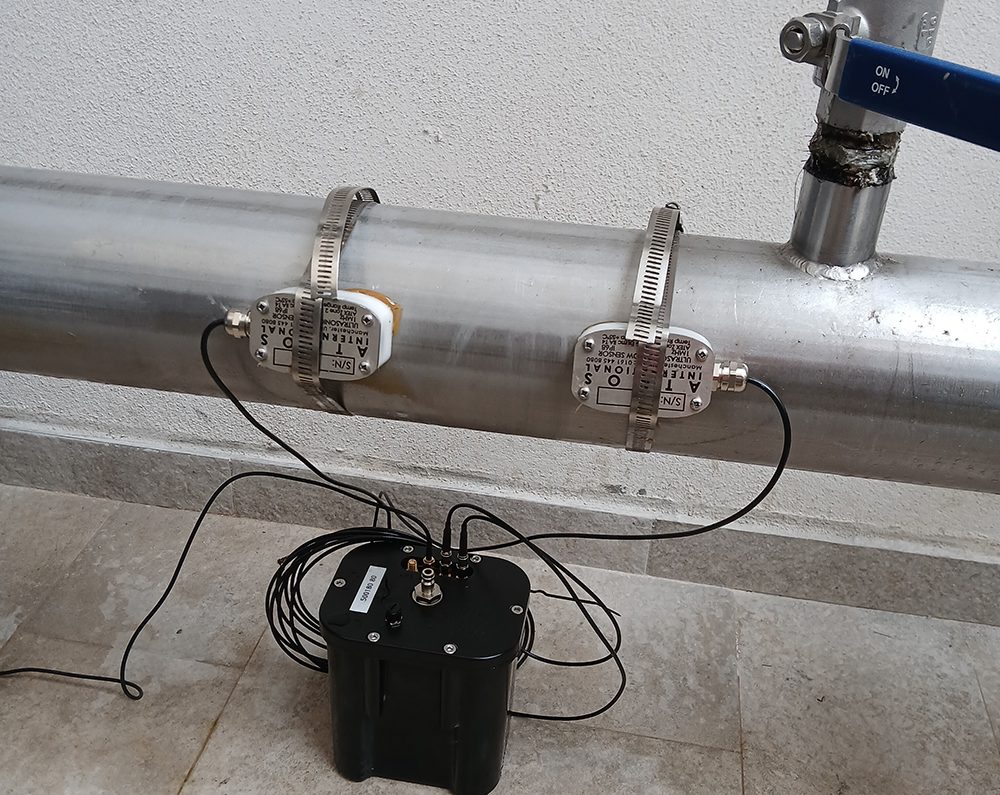
Clamp-on ultrasonic flow measurements (see Figure 1) allow flow data to be captured without cutting into the pipe or interrupting supply. By removing the need for inline installation works, these solutions can be deployed quickly and flexibly, opening up locations that would previously have been impractical to monitor.4
Modern non-intrusive systems are no longer limited to spot checks. Advances in data processing, communications and power management mean they can now acquire flow data over extended periods, with Edge processing transmitting it remotely and integrate into wider network analysis.
This makes them particularly well suited to the evolving needs of water companies, where understanding flow behavior across a wider area is becoming just as important as precision at individual assets.3
Supporting upstream and trunk main monitoring use cases
One priority application is flow verification on trunk mains that feed multiple downstream zones. Confidence in DMA data is fundamental to leakage management, yet meters can drift or underperform over time.3 A rapidly deployable, non-intrusive flow monitoring solution provides a practical way to verify performance without removing existing assets from service.4
Another growing use case is temporary flow monitoring on trunk mains. During maintenance activities, investigations or planned outages, in-line meters may need to be removed or bypassed. A clamp-on solution can be installed for the duration of the work, maintaining continuity of data without permanent modification to the pipeline.
There is also increasing interest in longer-term remote monitoring at key trunk main locations. While not intended to replace all permanent metering, non-intrusive systems offer a way to extend flow visibility into parts of the network where installing fixed assets would be difficult to justify.3,4 Over time, this contributes to a more complete understanding of how water moves through upstream systems under different operating conditions.3
Implications for leakage strategies
As utilities adopt more flow-based approaches to upstream leakage calculations, flexibility becomes critical.1 The ability to deploy monitoring quickly, relocate assets as priorities change and collect data without disrupting customers supports a more responsive and evidence-led strategy.
Better flow data does not just improve reporting, it enables earlier identification of abnormal behavior, more targeted investigations and greater confidence when making investment decisions.3 In a regulatory environment that increasingly rewards demonstrable outcomes, this level of insight is becoming a commercial advantage.1,2
Looking ahead
Flow measurement is moving from a supporting role to a foundational one in leakage management.3 As expectations rise, solutions that combine accuracy, speed of deployment and minimal operational impact will play an increasingly important part in clean water networks.
For utilities navigating regulatory changes, non-intrusive flow monitoring offers a practical route to better data, stronger decisions and more resilient upstream systems.
References
1 https://www.ofwat.gov.uk/wp-content/uploads/2025/03/Leakage-%E2%80%93-FD-PC-definition.pdf
2 https://www.ofwat.gov.uk/households/supply-and-standards/leakage/
3 https://www.water.org.uk/publication/a-leakage-routemap-to-2050/
4 https://ukwir.org/topic-catalogues-1