



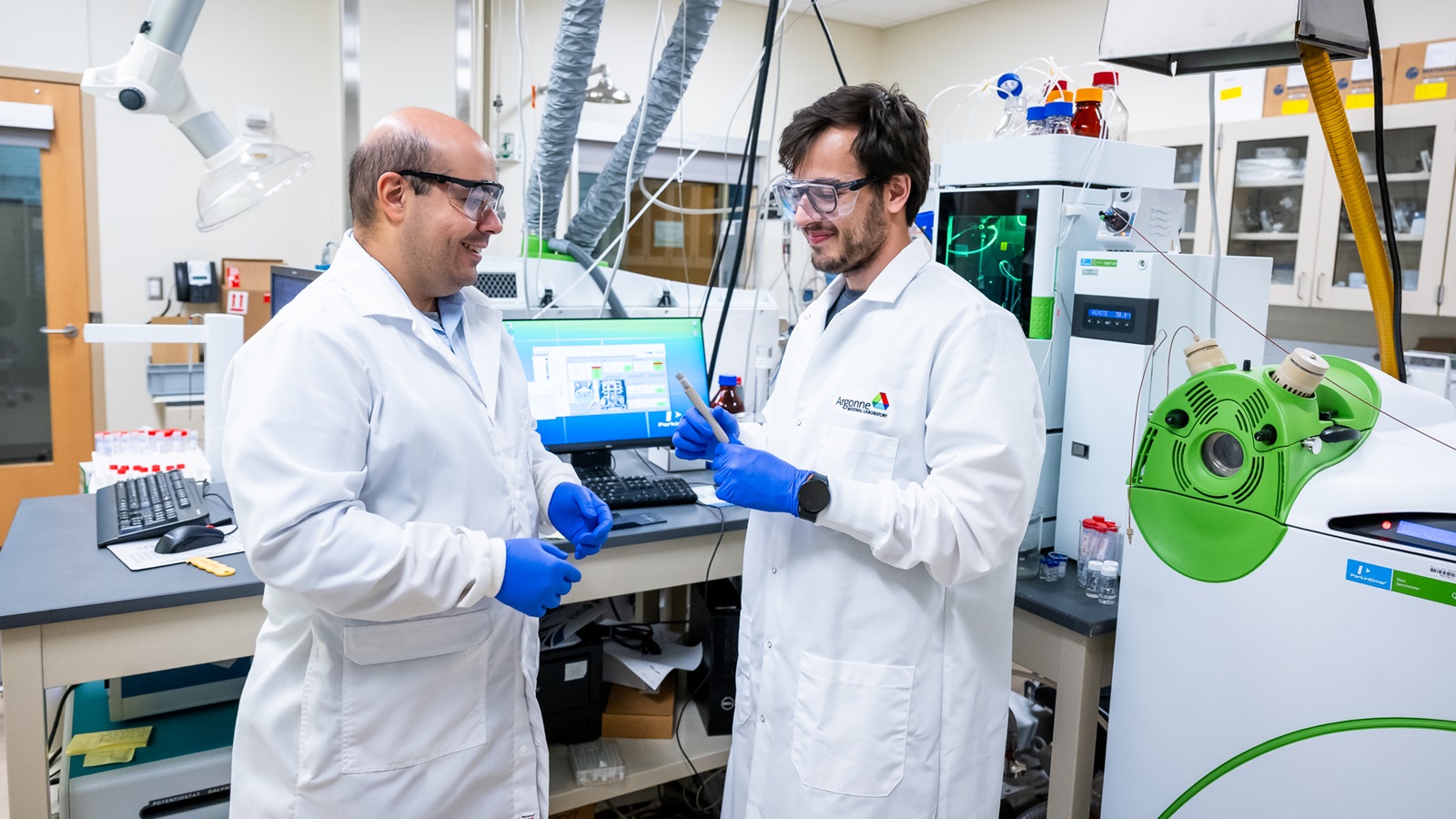
The detection technique opens new paths for clean water technologies, writes Joseph E. Harmon, of Argonne National Laboratory.
Reactive oxygen species are powerful enough to clean our water and more. Argonne researchers have found a highly sensitive way to measure them in real time.
From brightly colored textile dyes to persistent pesticides and antibiotics, many modern pollutants dissolved in water — such as Bisphenol A — resist traditional treatment methods.
A promising approach uses electricity to power chemical reactions in water over an electrode surface. Much like in a battery, electrodes send and receive electrical current that drives chemical reactions.
This process, known as electrocatalysis, generates a class of highly reactive oxygen-containing compounds, known as reactive oxygen species or oxidants, at the electrode surface.
These powerful oxidants, which include ozone and hydrogen peroxide, can break down even the most stubborn contaminants, producing cleaner water. However, because these oxygen species are unstable, degrade over time and exist in trace amounts — down to the parts-per-billion level — they have been notoriously difficult to detect and quantify.
“These oxygen species don’t last long, and they’re hard to detect individually. But knowing which ones are present and in what quantities is essential for improving water treatment technologies,” explains electrochemist scientist Pietro Papa Lopes.
In a study published in ACS Catalysis, researchers at the U.S. Department of Energy’s (DOE) Argonne National Laboratory report a new method for detecting and quantifying these short-lived oxygen species in real time with unprecedented sensitivity. Their approach revealed not only how much of each oxidant is produced, but also which specific species are formed under different treatment conditions.
“These oxygen species don’t last long, and they’re hard to detect individually,” Piero adds. “But knowing which ones are present and in what quantities is essential for improving water treatment technologies.”
The team’s findings have applications beyond water treatment, such as fuel cells which convert hydrogen or other chemical fuels into electricity. Another is electrolyzers. They can split water molecules to produce hydrogen fuel or convert carbon dioxide into aviation fuels, for example.
As a whole, the study provides a new benchmark for scientists and engineers working to advance electrochemical water purification.
By establishing a consistent, sensitive method for identifying and quantifying reactive oxygen species in electrochemical systems, the research enables better system design and more meaningful comparisons across experiments and technologies.