




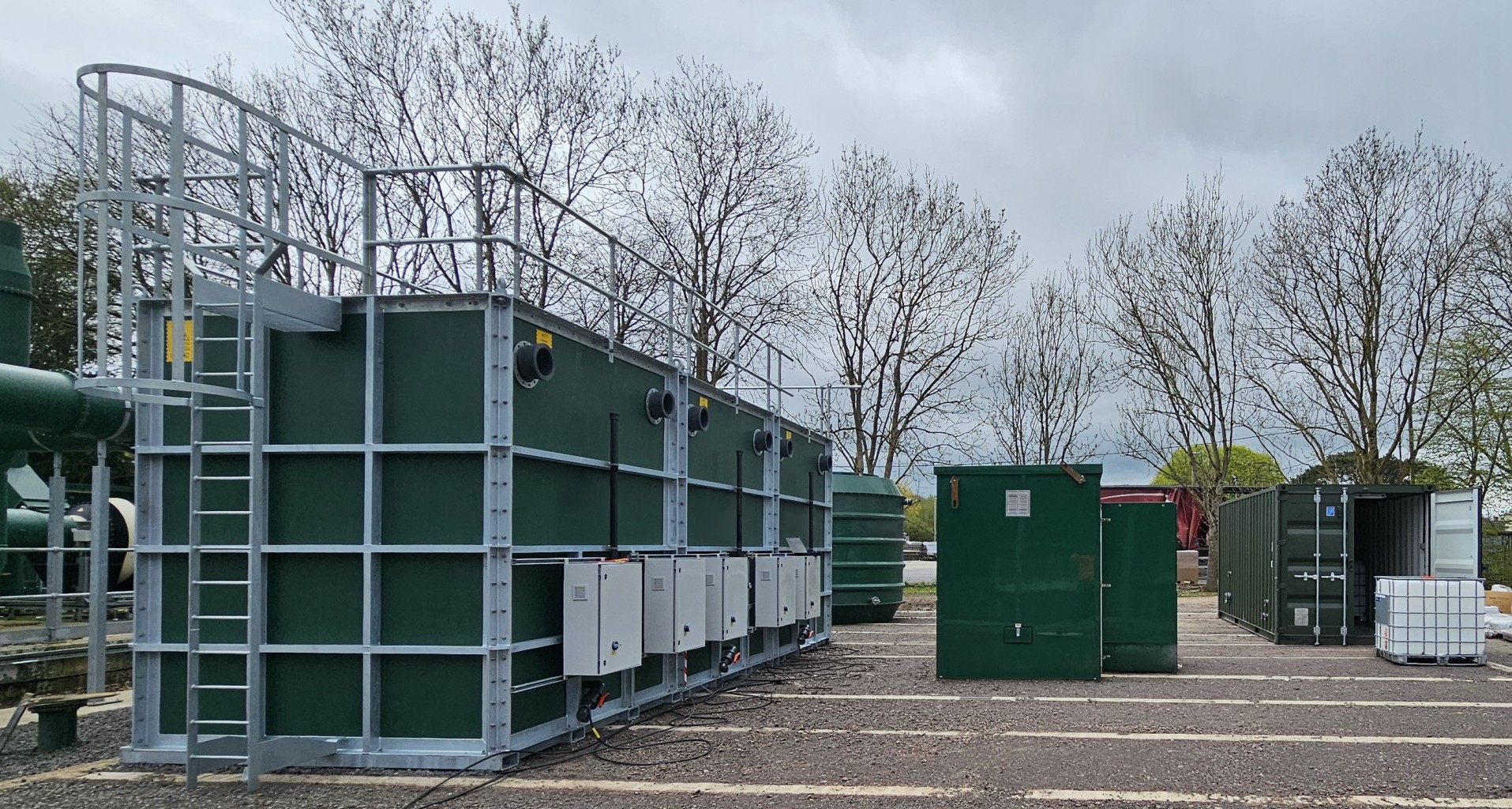
Wessex Water is taking part in trials of a nature-based wastewater treatment process that uses algae to break down contaminants.
The £1m agreement – a joint venture with wastewater firm Marlowe Environmental Services (MES) and technology company i-Phyc – will see the trials take place at Pen Mill water recycling centre in Yeovil, Somerset.
It’s all part of the water company’s regulatory research and development programme. MES equipment arrived onsite early April 2026 ready for the 12-month trial.
The project will explore multiple opportunities accruing from algae deployment in wastewater treatment.
These include phosphorus (P) and nitrogen removal to meet regulatory discharge consents, and nutrient neutrality planning requirements, along with potential for algae harvesting for fertiliser and biofuel feedstock.
Once commissioned, the system will pump wastewater into a biological treatment unit before it passes into a SludgeTEK centrifuge for dewatering.
It will then be dosed with i-Phyc’s micro-algae in a separate conditioning tank.
Managed exposure to light and air within the tank supports photosynthesis, encouraging phosphorus and nitrogen up-take.
At the end of the process the algae can be separated from the treated effluent and harvested or returned to the conditioning tank to be reused.
MES spokesman Andrew Baird said, “We are excited to be involved with this innovative project, having worked closely with i-Phyc over a number of years.
“They know about getting the best out of algae and we certainly know how to build the necessary wastewater processing equipment.”
“Wastewater operators face multiple environmental and economic pressures,” he added, “and there are many directions Wessex Water could take this R &D project.
“The main advantage for P-removal is that there is no chemical dosing.
“For nitrogen removal, no anoxic zone is required, which makes the system easier to control at different seasonal temperatures.”
“One of the areas we will be looking at is how colder temperatures inhibit algae growth, which is why the project is taking place over a year, to capture those climatic variations.
“It’s an environmentally friendly approach that could be of particular interest for smaller, constrained sites where reed beds aren’t an option.”