




Ever increasing phosphorous targets are driving wider adoption of advanced technologies, writes Duncan Wildgoose, business development manager, Xylem UK.
Interim targets for phosphorus removal – requiring water companies to reduce phosphorus in treated wastewater by 55% by December 2030 – are continuing to drive significant investment in infrastructure upgrades.
Announced by the Environment Agency in December 2025 and applying in England, these interim targets will measure progress towards a statutory 80% reduction by 2038. One year into the 2025-2030 investment cycle (AMP8), water companies are exploring new approaches to meet the tightening requirements.
Over the past decade, permitted phosphorus discharge limits have been progressively reduced – from typical limits of 1-2 mg/L to 0.25 mg/L and below in AMP8. While these numbers may appear marginal, the technical challenge is big – reducing phosphorus from 2 mg/L to 0.25 mg/L represents an eightfold decrease.
At these ultra-low levels, removing trace elements becomes much harder and traditional filtration-based methods begin to show their limitations. Water companies are questioning how to consistently achieve ultra-low levels, cost-effectively and at scale. Site footprint constraints and the rising cost of increased chemical dosing are also front of mind for project planners.
Ballasted clarification
One advanced solution continuing to gain traction is Xylem’s CoMag system, a ballasted clarification process, proven to consistently achieve phosphorus levels as low as 0.15 mg/L – and even 0.1 mg/L in both the UK and the US.
At the core of the process is magnetite, a dense, inert material that binds with phosphorus-containing solids. This creates heavier particles that settle rapidly – up to 10 times faster than conventional methods – enabling efficient separation within compact tanks. The result is a system that meets stringent discharge requirements at pace and scale, under varying load conditions.
This high-rate settling performance allows CoMag to treat large flows with just a small number of tanks, simplifying design and significantly reducing overall footprint. CoMag’s process efficiency is particularly valuable as companies face rising chemical and transport costs associated with dosing.
Compared to traditional filtration systems, the process typically uses around two-thirds of the ferric dose and additionally does not generate backwash water that adds hydraulic loading to the works. The cost savings over continuous, year-round operation are significant.
Operational ease is another key priority for water companies, particularly as site management becomes more complex, alongside ongoing workforce shortages. Unlike some filtration technologies, CoMag does not require frequent manual cleaning or intensive maintenance routines, helping to minimise operational burden.
Yorkshire target exceeded
Yorkshire Water adopted the CoMag technology at Knostrop Wastewater Treatment Works. Serving nearly one million people in and around the city of Leeds, Knostrop is Yorkshire Water’s largest wastewater treatment site.
The utility needed a solution that could deliver a phosphorus compliance level of 0.4mg/l, within the existing footprint and without significantly increasing costs. Xylem worked with Yorkshire Water to deploy the largest CoMag system installation in the world to date.
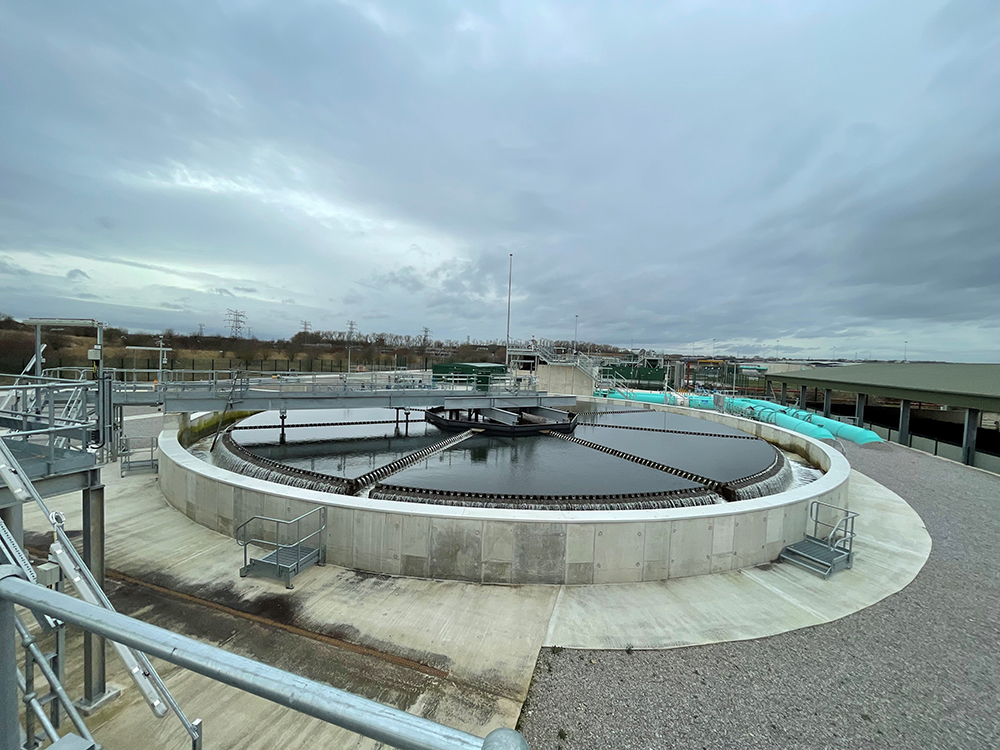
Due to the efficiency of the process, just one 32m high-rate CoMag clarifier was required. Following commissioning in September 2024, Knostrop’s CoMag system provides tertiary solids removal to 75% of the site’s full flow to treatment, helping achieve average total phosphorous of 0.25mg/l – exceeding the target.
As confidence grows in the technology, thanks to installations such as Knostrop, Xylem is seeing utilities become more comfortable reducing levels of redundancy. Traditionally, companies have favoured full duty-standby configurations, installing complete backup systems to ensure continuous operation if one stream goes offline.
However, for phosphorus removal – where compliance is measured on an annual average basis – many are switching to flexible configurations, such as two clarifiers each treating around 75% of the flow, or even a 50:50 split.
This allows full treatment during normal operation, while still maintaining resilience if one unit is temporarily offline. Given that CoMag shutdowns are infrequent and typically limited to planned regular maintenance, these decisions reflect a growing confidence in the technology’s reliability.
Looking ahead
While meeting current phosphorus limits is the immediate priority for water companies, suppliers like Xylem continually looking ahead to longer-term opportunities.
Key areas of focus include:
Phosphorus recovery – transforming waste into reusable resources
Digital optimisation – improving efficiency through data and modelling
Development of natural solutions – reducing reliance on ferric and alum
Deploying CoMag in other applications – such as stormwater and water re-use treatment.
Xylem is actively developing solutions in these areas, supporting utilities not just in AMP8 compliance, but in building more sustainable treatment systems for the future.
More information at xylem.com/en-uk.