



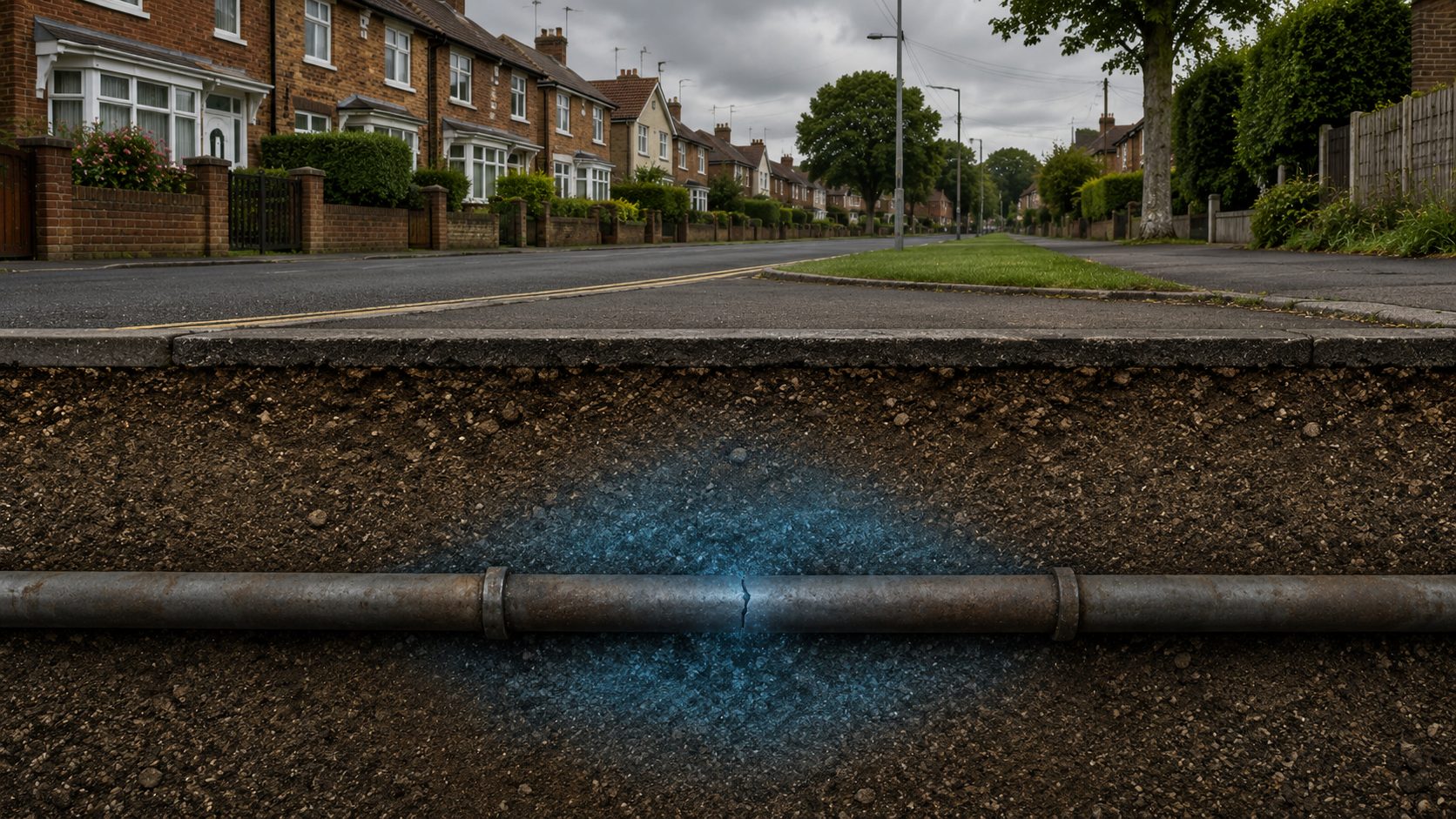
Every day a leak remains undiscovered, treated drinking water escapes from the network and operational costs accumulate. For utilities managing thousands of kilometres of buried infrastructure, the value of any leak detection programme is not measured by the number of anomalies identified, but by how quickly teams can move from potential leak indication to confirmed repair and water savings.
Satellite-based leak detection is being widely adopted as a large-scale network screening tool to help utilities identify where hidden leakage may be occurring. In the UK, these services are delivered through SUEZ as the trusted delivery partner for ASTERRA’s satellite technology, combining advanced detection with in-country operational expertise. As adoption grows, an important distinction is emerging; not all satellite technologies observe the same conditions, and not all approaches provide the same level of confidence when prioritising field investigations.
Leaks Can Manifest in Different Ways
Many underground leaks begin as subsurface moisture conditions long before visible signs appear at ground level. Over time, they may contribute to standing water, pavement deterioration or ground movement, but these indicators do not always appear. Industry estimates suggest that 80–90% of leaks in UK water networks maybe non-surfacing, making early detection and investigation prioritisation especially important for reducing leak run time.
When visible indicators do appear, they can also be influenced by rainfall, irrigation, groundwater or other environmental conditions. For utilities, the challenge is therefore not simply identifying anomalies across a network. It is determining which anomalies are most likely associated with actual leakage and should be prioritised for field investigation.
Different Satellite Technologies Observe Different Conditions
Different satellite-based approaches contribute different types of information to leak investigation workflows.
Some technologies, such as multispectral or optical imaging, focus primarily on surface-level conditions associated with leakage, such as vegetation response or standing water reflectance. Others, like InSAR, monitor structural consequences such as ground deformation or subsidence. Other approaches, including ASTERRA’s L-band PolSAR technology, focus directly on moisture-related subsurface conditions by analysing how radar signals associated with treated drinking water interact with environmental moisture below the surface.
As utilities evaluate satellite technologies, understanding what type of condition a technology is actually observing becomes increasingly important.
Improving Prioritisation Confidence
This distinction matters because confidence in the signal directly affects how field teams prioritise investigation. ASTERRA’s approach is designed to identify non-surfacing potable water leaks by focusing more directly on moisture-related subsurface conditions rather than relying primarily on visible surface response or structural consequences. This can help utilities prioritise potential leak activity before standing water, pavement deterioration, measurable ground movement, or other indicators become operationally apparent – if those conditions emerge at all.
This is especially important for utilities managing large service areas, ageing infrastructure, limited field crews and high volumes of non-visible leakage. Stronger prioritisation helps reduce unnecessary field work, improves crew productivity and shortens leak run time.
A UK project with Anglian Water demonstrates this approach in practice. Satellite-based leak detection was used to support investigation across a large rural trunk-main network where non-surfacing leaks were difficult to locate using conventional approaches alone. The programme identified leakage across hard-to-access areas, with 95 leaks found from 105 investigated locations, including 41 trunk main leaks. The project resulted in reported daily savings of approximately 2 megalitres per day, demonstrating how targeted investigation can help utilities move more quickly to confirmed water savings.
Similar results were seen with SES Water, where 219 leaks were found over 59 days of inspection work. Of those leaks, 94% were classified as non-surfacing, with reported savings of 0.9 megalitres per day.
Supporting More Proactive Leak Management
Satellite technologies are not intended to replace field validation or acoustic inspection. Instead, they function as a large-scale screening and prioritisation data layer within a broader leak management strategy.
ASTERRA’s satellite intelligence platform helps utilities screen large areas of pipeline infrastructure quickly and non-invasively, allowing field teams to focus investigation activity where operationally relevant leak conditions are most likely present. As part of a broader leakage strategy, satellite-guided prioritisation can support:
- shorter leak run time across the distribution network
- improved crew productivity
- lower operational cost and higher efficiency
- more proactive leak management
- and overall improvement in non-revenue water management.
In the UK, SUEZ and ASTERRA’s work has contributed to 23,031 confirmed leaks identified and approximately 1,306 megalitres per day of water saved to date. As water companies face increasing pressure to reduce non-revenue water, improve efficiency and manage ageing infrastructure, this combination of satellite intelligence and local delivery expertise can help turn network data into faster investigation, repair and measurable water savings.