




Ross Brace, filtration business manager at Hydro International, explains what water utilities should consider to ensure their tertiary treatment equipment effectively tackles phosphorous
Phosphorous is an essential element for sustaining plant life – but too much can cause harm. Excess phosphorous concentrations in surface water bodies cause algae blooms, negatively impacting marine biodiversity. Achieving the right balance is crucial for healthy waterways.
That is easier said than done, however. According to UK Government data, over half of rivers and three quarters of lakes in England fail to achieve good ecological status due to greater than permissible phosphorous levels.
While research shows that phosphorous loadings from sewage treatment works have decreased significantly in the past 30 years, they still account for around 55 per cent of phosphorous loadings into English rivers.
Tertiary treatment of wastewater has an important role to play in tackling these excess nutrients by removing phosphorous. AMP8 will see UK utilities providers investing millions in upgrading their wastewater treatment capabilities, but what should they keep in mind to ensure that the equipment removes phosphorous effectively?
The need for confidence in compliance
Tertiary continuous sand filters have successfully been used to remove nutrients from wastewater since the 1980s. But with UK phosphorous limits expected to become more stringent, there’s a need to update proven systems to meet new regulations. Forward-thinking operators are already applying these technologies to boost efficiency.
Take for example the Brightwork Moving Bed Filter (MBF), which is equipped with Sand-Cycle technology that is being used by several major water utilities to control and automate the filtration process to increase process efficiency.
The ability to alter the filter sand washing rate to the quantity of solids present in the water enables more effective removal. Analysis revealed that such a controlled system can increase phosphorus removal by 50 – 60%, allowing more stringent consent levels to be obtained.
As environmental regulations tighten, employing autonomous sand filter technologies could be the difference between compliance and failing to meet treatment standards.
Smart monitoring enables better maintenance
With wastewater operators typically needing to carry out either 12 or 24 water quality samples a year as part of their self-monitoring environmental permits, detecting and fixing equipment issues quickly helps to ensure that phosphorous levels remain within allowable limits.
However, since treatment technicians often oversee multiple sites remotely, these issues may not be identified until scheduled sampling is undertaken, meaning that phosphorous-enriched water could potentially be discharged for weeks before the equipment is fixed.
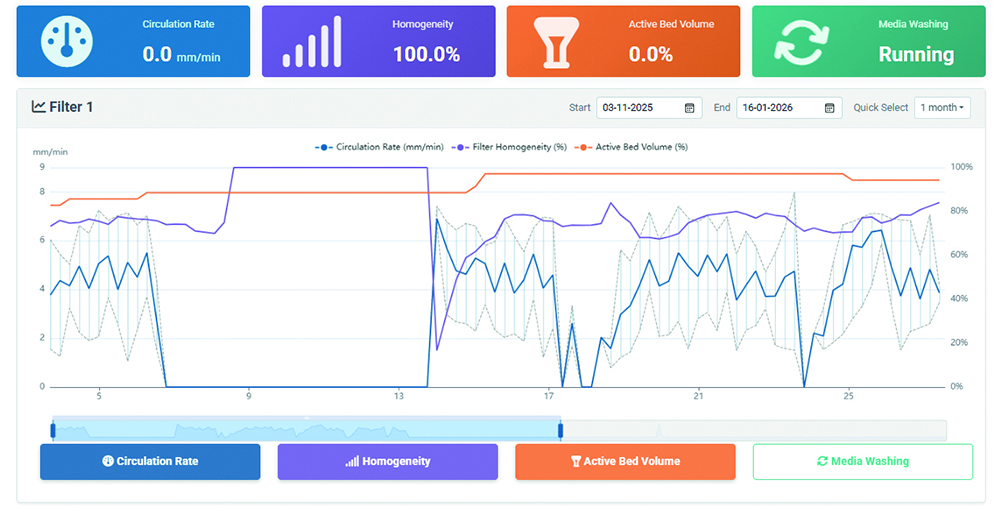
Choosing sand filtration technology with built-in smart monitoring systems enables operators to tackle problems proactively. Sand-Cycle uses radio frequency identification (RFID) tags in the sand filter bed to collect and process real-time data on the sand circulation rate and filter performance.
If the tags are not moving as expected, this generates an automatic alert that can be viewed through a remote dashboard, allowing it to be remedied quickly. Early action makes it easier and more cost effective to fix the filters without replacing the sand.
The technology is compatible with various models of moving bed filters, helping businesses to monitor and maintain older assets.
Leaving room to grow
The Environment Agency estimates that the UK will need an extra five billion litres of water each day by 2050 in order to meet demand. A high volume of the water supplied will end up passing through the sewage system, putting it under increased strain.
Opting for a modular filtration system that can be manufactured offsite means that wastewater operators can add wastewater treatment modules as needed, with shorter lead times thanks to greater standardisation.
Making the right tertiary treatment choices now will help utilities to effectively tackle nutrients, meet environmental regulations and protect ecosystems long beyond the AMP8 period and well into the future.