




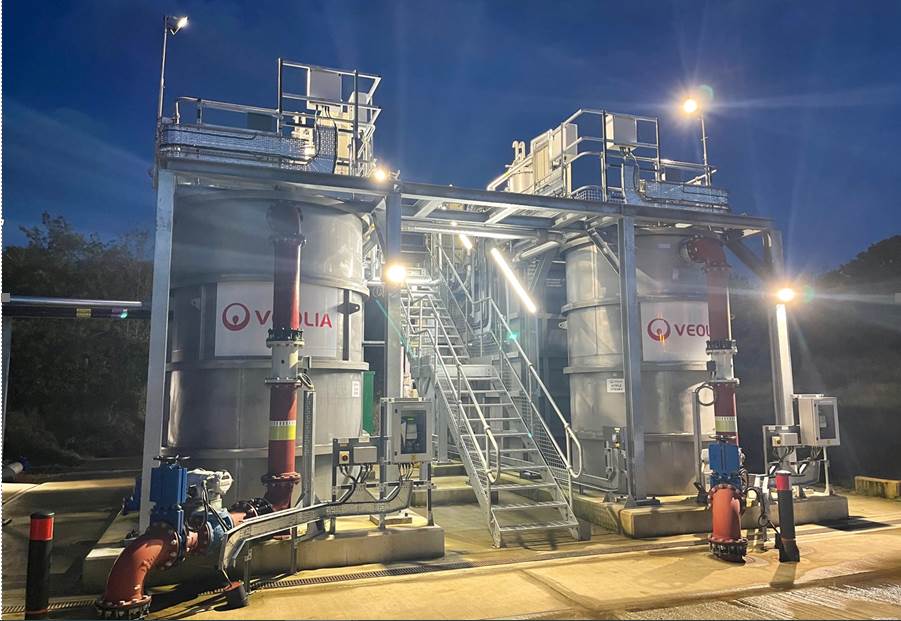
Phosphorus is one of the most important issues in municipal wastewater treatment in AMP8. Here, Daniel Parry, Head of Sales – Municipal and Industrial, Water Tech, at Veolia, outlines what this means for operators and the technologies available to meet tightening standards.
Phosphorus is an essential mineral for agriculture and human health, but excess quantities in watercourses can cause serious damage to aquatic ecosystems through eutrophication and oxygen depletion.
While high levels of phosphorus in rivers has traditionally been attributed to fertiliser use on farmland, effluent from wastewater treatment facilities now accounts for around twice as much (60 to 80%) of the total. To address this, progressively tightening limits are being introduced for phosphorus in treated wastewater.
In England, this is being driven by the Environment Act 2021 and the supplementary Environmental Targets (Water) (England) Regulations 2023. This legislation sets a legally binding target to achieve a 50% reduction in phosphorus loadings to watercourses by 31st January 2028, compared to the 2020 baseline, on the way to an 80% reduction by 31st December 2038.
This means operators now need to consider upgrades to water treatment processes to ensure compliance can be achieved. There are three main categories of technology that can be used to deliver enhanced water treatment – biological, chemical and filtration.
Biological
With this type of treatment, microorganisms are grown in the water that assimilate phosphate for growth and also absorb and store phosphorus as polyphosphate in a process called enhanced biological phosphorus removal (EBPR). The phosphorus becomes part of the biomass, which is then separated from the treated water at the end of the process. A solution based around a Moving Bed Biofilm Reactor (MBBR), is ideal for many facilities and can also help to remove carbon and nitrogen.
Chemical
With this approach, a metal salt or organic alternative is added to a new or existing treatment system, such as a clarification-based solution, to precipitate ortho-phosphate. The precipitate forms as a solid (flocs) and is removed in either a settlement tank or a tertiary solid capture process, such as a disc or sand filter.
Some systems can offer enhanced performance. For example, our Actiflo® clarifier solution utilises microsand to ballast the chemical flocs, significantly increasing the settling velocity of the particles. This delivers very short retention times and a more compact design – a footprint much as 40 times smaller than conventional clarifier systems.
Filtration
Filtration technologies, such as our Hydrotech™ disc filter and cloth filter, can provide an excellent solution for phosphorus removal. A fine media mesh or cloth mounted on a number of rotating discs is used to effectively remove a range of contaminants, including phosphorus. Filtration offers a flexible and modular solution with a comparatively low TOTEX – the total expenditure combining CAPEX and OPEX.
There are also solutions that combine biological treatment with high-grade filtration to achieve very high levels of water quality. As an example, our ZeeWeed™ membrane bioreactor (MBR) utilises an ultrafiltration (UF) membrane that not only removes suspended solids and nutrients but also bacteria and viruses to achieve reuse-quality water.
Partnering with a treatment specialist
Selecting the correct solution for a given site is complex as a range of factors need to be considered. This includes the existing plant, current performance of the treatment process, the level of phosphorus in the influent, wastewater variability, and site constraints. Partnering with a leading water treatment specialist, such as Veolia, that has expertise, experience and a wide range of technologies, can help ensure the optimum solution for the application.
To find out more about Veolia’s phosphorus removal solutions visit veoliawatertechnologies.co.uk.