



The UK’s lead pipe replacement programme is, in theory, one of the most straightforward public health interventions imaginable: find the pipes, replace them, protect people. In practice, it’s proven stubbornly difficult to deliver at pace. Water companies are struggling to meet their own targets. Programmes are pausing. And the gap between ambition and reality keeps widening.
That’s not because the sector lacks commitment. It’s because the delivery challenges are genuinely hard and understanding what causes projects to fail (or stall) is the first step to understanding what makes them succeed.
The Real Barriers to Delivery
Water companies are candid about the obstacles in their own regulatory submissions. One AMP8 lead strategy submission to Ofwat by a major UK water company noted that at their then-current replacement rate it would take 450 years to replace all lead pipes in their area. The primary blockers they identified were the high cost of individual interventions, low customer uptake, and the disruption involved factors that compound each other. If customers are reluctant to engage because of the disruption involved, programmes slow.
Their own research found that customer support for the pace of lead investment dropped when the bill implications were made clear. People want the problem fixed; they’re less certain they want the upheaval and even less certain they want to pay for it.
The other challenge is property access. Traditional lead pipe replacement typically requires excavation to access the pipe running underground from the street, and to work through internal floors and walls to reach pipework inside the building. In occupied housing, both of these create real barriers.
What Successful Programmes Have in Common
Looking at the programmes that have delivered consistently, a few principles emerge.
Speed at the individual job level matters enormously
When a single replacement takes a full day or longer, programme targets become very hard to hit at scale. Jobs that can be completed in hours – with minimal reinstatement required – allow contractors to turn over more properties per day, keep customers onside and give utilities meaningful throughput against their targets.
Access flexibility determines scope
Programmes that can only work in straightforward ground conditions will always leave a significant portion of the housing stock unaddressed. The properties that are hardest to reach are often the ones with the oldest pipework and the highest risk.
Reducing the customer ask increases uptake
The more intrusive the works, the more customers will decline or defer. Schemes that can replace pipes with minimal internal access – or ideally none at all – see higher acceptance rates and fewer aborted visits.
Scaling Up Needs a Different Approach
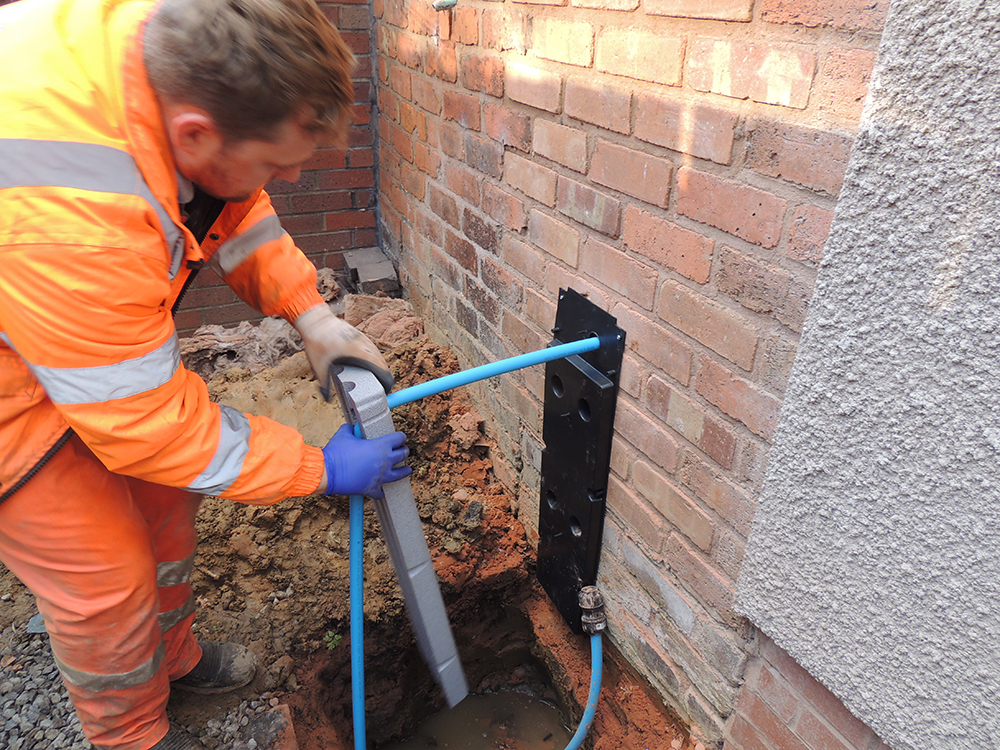
At Groundbreaker Systems, our INSUduct® solution was designed specifically around these delivery realities. It’s an external duct system that allows new water services to be installed above ground, running up the outside of a building, without excavating internally or requiring tenants to vacate. Installations are typically completable in under two hours.
For sites where ground conditions prevent standard burial depths – rock, tree roots, existing foundations – our SHalloduct™ provides compliant frost-protected installation at reduced depths, keeping programmes moving where conventional approaches would stall.
AMP8 (2025–2030) has raised the stakes. The Drinking Water Inspectorate has issued formal undertakings to multiple water companies requiring delivery of specific lead pipe replacement targets and companies are expected to report progress. The programmes that will hit those targets won’t be the ones relying solely on traditional methods, they’ll be the ones that have genuinely rethought how individual jobs are scoped, staffed, and completed.
The bottleneck in lead replacement isn’t political will or regulatory pressure. Both exist. It’s delivery: getting to the door, getting the job done and moving on – without leaving a disrupted household behind.
Interested in how Groundbreaker’s products support large-scale lead pipe replacement programmes? Head to our solutions pages or get in touch to discuss your project.