



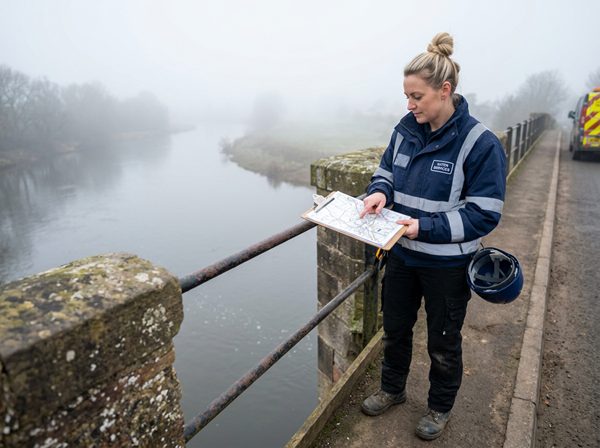
On excavation sites across the UK water industry, one piece of equipment is being underused every working day – and the cost is being paid in strikes, injuries, and emergency repairs.
Walk onto any water network excavation in the UK, and you’ll see a familiar piece of kit in an operative’s hand: the Cable Avoidance Tool, or CAT. What you’ll see less often – lying somewhere in the back of the van – is the Genny. The signal generator that turns the CAT from a useful indicator into a genuinely reliable detection system.
This is not a training problem. Most operatives know what a Genny does. It’s a habit problem. And according to Peter Ashcroft, founder of Sygma Solutions – the UK’s only independent specialist in underground utility location and avoidance training – it’s costing the water industry dearly.
The passive-detection blind spot
The CAT operates in two passive modes. Power mode reads electromagnetic fields off live electricity cables when those cables happen to be carrying a load – a connected-but-idle cable, or one carrying a balanced three-phase load, may produce little or no detectable signal. Radio mode reads VLF signals re-radiating off long buried conductors, with strength depending on length, depth, soil conditions, and proximity to other buried metals. Short runs of metallic service often don’t broadcast enough to register. Passive modes find what happens to be broadcasting at the moment you walk over it, not what is there.
The Genny removes that uncertainty. It applies a known signal at a known frequency directly to a target asset, and the CAT, in Genny mode, reads back what you put there. Used together, the two tools are a different proposition entirely. Used apart, which is what happens on most sites, they offer false confidence.
For water network operatives, the consequences are particularly acute. Excavations for service connections, leak repairs, mains replacement and new connections frequently sit in congested utility corridors. Gas, electricity, telecoms and other water assets are often within centimetres of the target dig. A strike on any of them brings the same outcome: emergency stops, third-party repair bills, regulatory exposure, and, in the worst cases, serious injury. The reputational damage with the asset owner can outlast any one project.
What changes when Genny’s use becomes the default
Sygma Solutions has been delivering CAT and Genny training to the UK utilities sector since 2004, including to major water industry clients such as Severn Trent Water and Scottish Water, who now refer to the methodology as “Genny & CAT”. Across that client base, Peter Ashcroft says one finding has been consistent: when training is restructured to put the Genny first rather than treating it as an optional second step, measurable Genny usage on site increases by 70 to 80 per cent.
This is not a satisfaction score. It is data pulled directly from locator downloads – the same data that any contractor running modern equipment can audit themselves. The trained operatives are simply using the Genny more, on more digs, more consistently. Before the intervention, Sygma reports that Genny-use rates on the same workforce typically sit in the low double digits after the curve flips.
The strike reduction that follows is the obvious commercial benefit, but the operational gains run further. Crews who use the Genny routinely identify services faster and dig with more confidence. The downstream effect on programme certainty – fewer stand-down hours, fewer reactive utility searches, fewer change-control conversations – is significant.
Why doesn’t the habit form by default
If the methodology is so straightforward, why is it not already standard? Three reasons recur on site visits across the country.
The first is the training structure. Most cable avoidance courses introduce the CAT first and the Genny second, often in a compressed half-day format. Operatives leave the course with the CAT as the “main tool” mentally fixed, and the Genny as the accessory. That mental model is hard to undo later, and refresher training that follows the same sequence reinforces it rather than correcting it.
The second is time pressure. Connecting a Genny – selecting a clamp or direct connection, applying the signal, walking the sweep – takes a few minutes longer than a passive sweep. On a programme running tight, those minutes feel like a tax. They aren’t. They are the difference between a controlled dig and a third-party damage report. The arithmetic only ever runs one way when a strike actually happens.
The third is reinforcement. Without on-site competency assessment between formal training cycles, there is no mechanism to catch operatives slipping back into CAT-only habits. Certification at the gate doesn’t equal competence on the dig, and the gap between the two widens every month a refresher isn’t due.
The case for restructuring
The Genny-First approach is not a product. It is a training sequence and a site-level expectation. It works because it inverts the muscle memory: operatives learn signal application before passive sweeping, and the Genny becomes the start of the procedure rather than a backup option to reach for if the CAT looks uncertain.
For water industry HSEQ teams reviewing their training programmes this year, Peter argues the question worth asking is not whether their operatives are certified to use a CAT and Genny. It is how often the Genny is actually being connected on live sites – and what the locator data says about it.
The answer, in most cases, is that the gap between certification and behaviour is wider than anyone is comfortable with. Closing it doesn’t require new equipment, new contractors, or new regulations. It requires a deliberate shift in how operatives are trained to think about the first thirty seconds of every dig.