




Reducing disinfection by-product risk through real time water quality monitoring.
Yorkshire Water supplies essential water and wastewater services to over five million people across the Yorkshire region in the North of England. The utility operates over 670 water and wastewater facilities and has a network of nearly 50,000 miles (over 80,000 km) of clean water and wastewater infrastructure.
In 2020, Yorkshire Water introduced a new strategy to address water quality challenges at a treatment works which receives its source water from the peatland catchments in the Area of Outstanding Natural Beauty (AONB) of Nidderdale. The raw water from these upland catchments is naturally rich in organic material, creating conditions that increase the potential for disinfection by- product (DBP) formation during treatment to be close to the permitted levels.
Over previous years, incremental improvements have been made to manage the challenge of treating this raw water, including peatland restoration, additional pre-treatment processes and automatic coagulation control instrumentation. These approaches improved final water quality at the plant, but further steps were required.
To enable source water selection and keep DBP formation potential as low as possible (a primary driver for this project), Yorkshire Water’s Water Quality Strategy team developed a smart source water quality selection programme.
Source Water Selection Protocol
Yorkshire Water trialed a process that used low power, IoT enabled sensors to identify the raw water sources that were best suited for treatment as any given time. The team hoped that by selecting source water with the lowest potential for DBP formation, they could improve final water quality, and maintain DBP compliance.
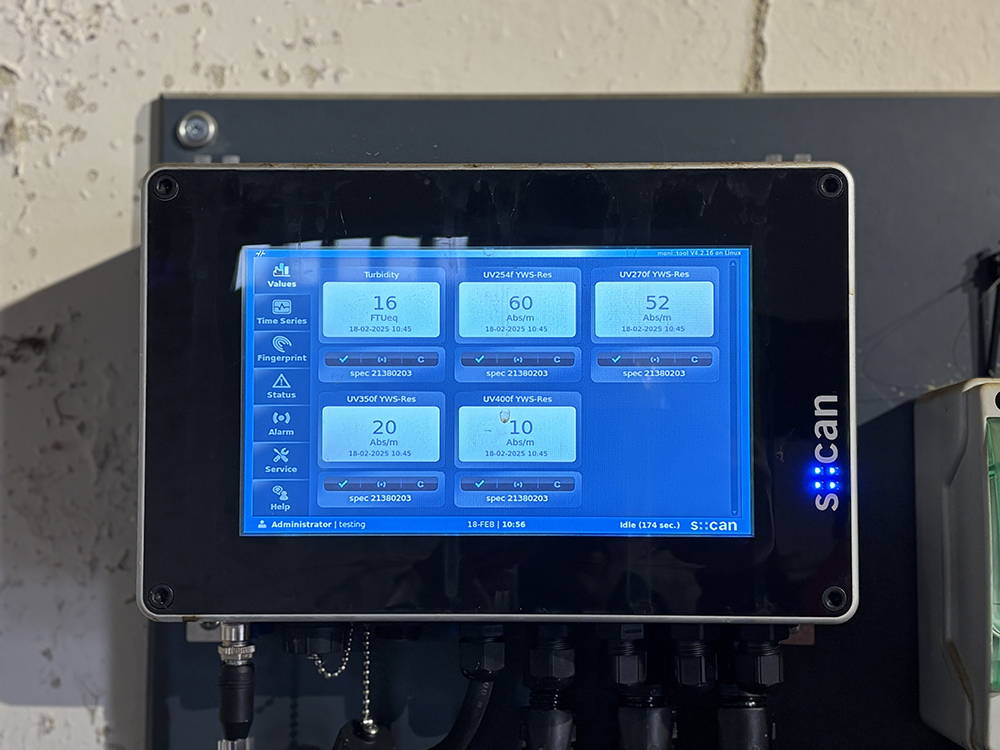
In 2021, a pilot study was launched at one of the many reservoirs in the area serving the treatment works to determine feasibility for such a project. The pilot deployed a s::can uv::lyser, a full UV-Vis spectrophotometer, which measures absorbance across multiple UV wavelengths to provide accurate real-time water quality data.
Following a successful trial, a total of 13 uv::lyser sensors were delivered to Yorkshire Water in 2022, providing the data for an intelligent source selection project.
Water Quality Sensor Configuration and Implementation
For Yorkshire Water, each uv::lyser measures UV254, true color and turbidity—key parameters for tracking organic loading and DBP formation risk. For research and development purposes, two additional UV wavelengths are monitored to help Yorkshire Water better understand seasonal changes in the Dissolved Organic Carbon (DOC).
To optimize performance at remote sites, the sensors were deployed without a traditional controller, reducing energy demand and long-term operating costs. All the sensors can be configured and managed using the onboard IoT connectivity.
Although the sensors arrive factory calibrated, Yorkshire Water evaluated site specific data during the pilot phase and applied minor calibration adjustments to reflect installation conditions. This enables Yorkshire Water to deploy the sensors across the area without having to calibrate each sensor individually. Once validated during commissioning, no further calibration is anticipated, minimizing operational expense.
“This project has delivered a low cost, low carbon, high tech solution to enable a better understanding of the chemistry of organic release from peatland catchments,” said Neil Whitehead, Water Catchment and Production Strategy Manager at Yorkshire Water. “This has helped with optimal selection of raw water sources and supports consistently high treated water quality.”
Operational Insights
The operational framework is now well defined, and Badger Meter will be supporting the Yorkshire Water team in the implementation phase next.
This approach will use a simple traffic light system driven by water quality sensor data across the catchment to guide source selection at the treatment works. This proactive system allows Yorkshire Water to choose the water they want to treat, reducing the need for carbon intensive solutions to a problem that can be resolved in the field by using smart sensors.
By deploying smart, low power water quality sensors across their catchments, utilities can gain deeper insight into long term catchment dynamics and achieve more resilient and cost-effective operations.
At Yorkshire Water, water quality monitoring tools help keep DBP formation as low as possible in treated water, deliver a solution which is consistent with their net zero targets and gain a better understanding of the source water changes over time.
For more information visit badgermeter.com/smart-source-water.